
Across Oceans with John Blandy
Trade, Endurance, and Ambition in the Madeira Wine World
A narrative history exploring the discipline, commerce, and maritime culture that shaped the 19th-century Atlantic wine trade.
In the late eighteenth century, England offered limited prospects to those without capital or connections. At the same time, Madeira stood at the crossroads of the Atlantic world—foreign, yet already shaped by British trade and custom. John Blandy chose Madeira out of necessity and foresight.
Prologue
When Daniel Defoe published Robinson Crusoe in 1719, he introduced Britain to a new kind of hero. Crusoe does not conquer or inherit; he observes, learns, and adapts. Alone, with little more than his judgment to guide him, he transforms an unfamiliar place into a livelihood. Often read as an adventure, the story is really about something more modern: the belief that a man can forge a future from resilience, observation, and trade, even when starting with nothing.
Nearly ninety years later, John Blandy would realise that concept. In 1807, he lived within the uneasy security of Britain’s middle-class commercial sphere, where respectability depended on trade, credit, and the smooth passage of goods overseas. The Napoleonic Wars did not ruin such families overnight; instead, they applied a slow, unyielding pressure. Markets shrank, shipping faltered, insurance premiums increased, and opportunities diminished.
Amid this tightening world, 24-year-old John Blandy embarked on his own Crusoe experiment — not on a desert island, but on a volcanic Atlantic outpost called Madeira — establishing the foundations of a trading business that would endure for more than two centuries. He left Dorset with only a letter of introduction from Richard Fuller, a banker in London. The letter, dated 23 December 1807, was addressed to successful wine merchants in Madeira and one of the island’s leading British shippers. It said:
“We beg to introduce Mr John Blandy, who visits your island on account of ill health, and wishes to obtain employment in a Counting House. We will be obliged if you can promote his views, and accordingly recommend him to your attention.”
Source Blandys Wine Lodge — www.blandys.com
John thus began working on the accounts of a successful Madeira wine merchant: Messrs Thomas Newton, Thomas Gordon, Thomas Murdoch, and Robert Scott. Three years later, in 1811, John Blandy had learnt the trade and set up his own family business, which was later joined in Madeira by his brothers! More about that later. First, let's explore John’s journey and Madeira as they were in 1808.
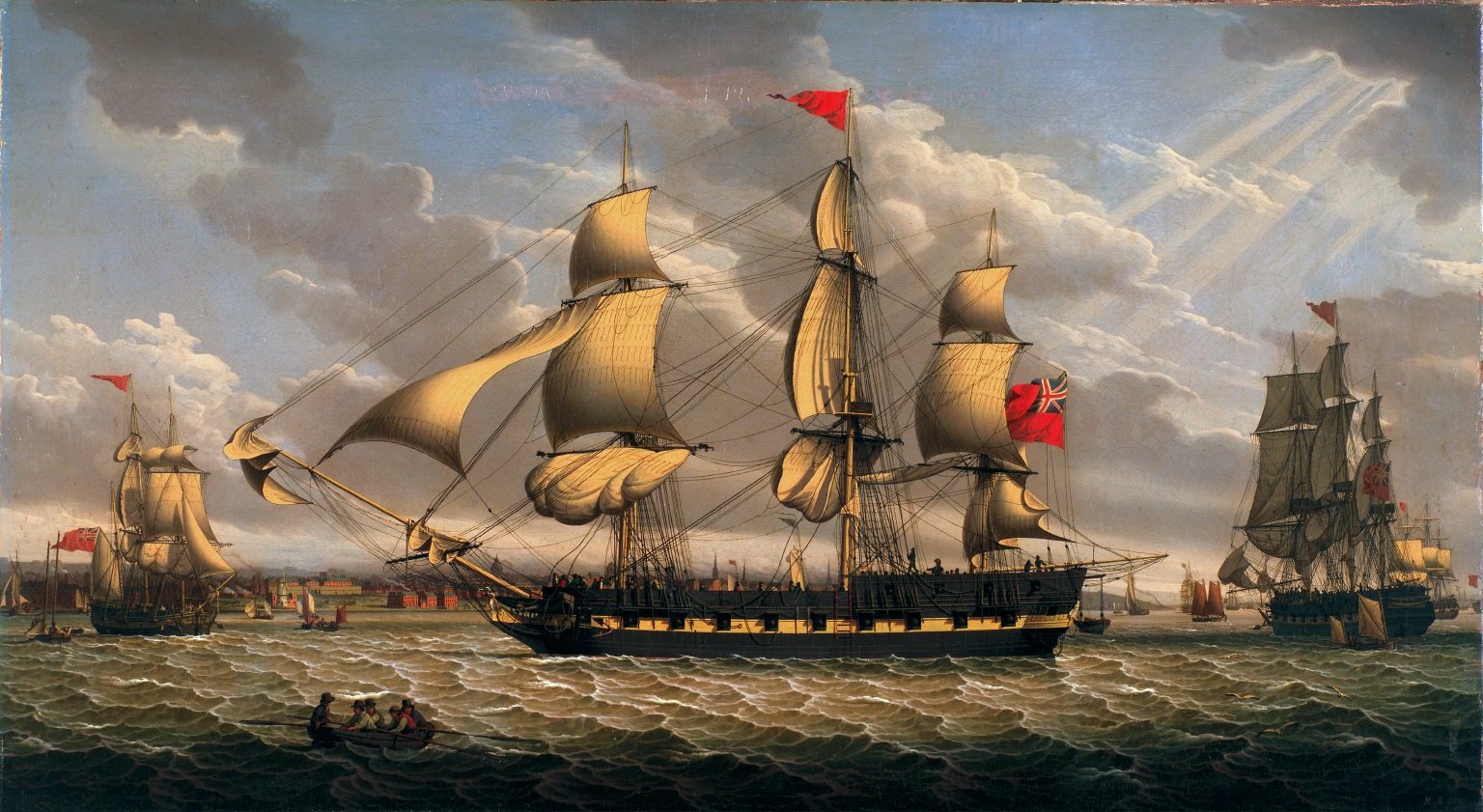
British Packet Merchantman by Robert Salmon, 1809
Journey
John Blandy’s journey to Madeira began long before reaching the sea. His departure involved first leaving his family’s Dorset farm and home by coach and horses, heading for the coast. He set out before dawn, trunks strapped high, letters of credit and introduction secured in a leather case, changing teams at posting inns as the miles fell away. Southampton, the nearest great harbour, Portsmouth, or London’s busy Thames docks were not just ports but gateways: places where inland merchants were transformed into Atlantic adventurers.
At the quayside, John Blandy stepped into a world shaped by war. Ships waited not only for the tide and wind but also on convoy instructions, with their departure dates uncertain and their destinations undisclosed. When he finally boarded, the coach journey was over, but the real risk was just beginning. The brief, bumpy ride from Dorset to the coast had taken him out of England; the long Atlantic crossing would usher him into a new business life.
Boarding the ship, he was greeted by the creak of tackle and a sharp smell of tar, salt, and damp timber, where sailors bent their backs to the last barrels of biscuits, beef, and fresh water. Britain was at war with Napoleonic France, and the harbour would have been alive with tension: convoy lists were checked, papers scrutinised, where rumours of French privateers traded as readily as tobacco.
Once aboard, comfort quickly gave way to confinement. The cabins were narrow and dim, shared with trunks, crates, and the ship’s constant movement; those without means slept where they could, swinging in hammocks or bedding down on rough boards. As the coast receded, days settled into a strict routine—watches called, sails trimmed, meals taken when the weather allowed—punctuated by bouts of seasickness, boredom, and sudden fear when strange sails appeared on the horizon.
An Atlantic crossing by sail was neither swift nor gentle: weeks of rolling seas, squalls, and oppressive calms tested patience and nerve alike. Yet as Madeira finally rose from the water, its terraced hills green against volcanic rock, the ordeal acquired meaning. For John, arrival was not merely landfall but survival, a passage through war, weather, and doubt into a place of promise, trade, and uneasy refuge at the edge of Europe’s conflict.
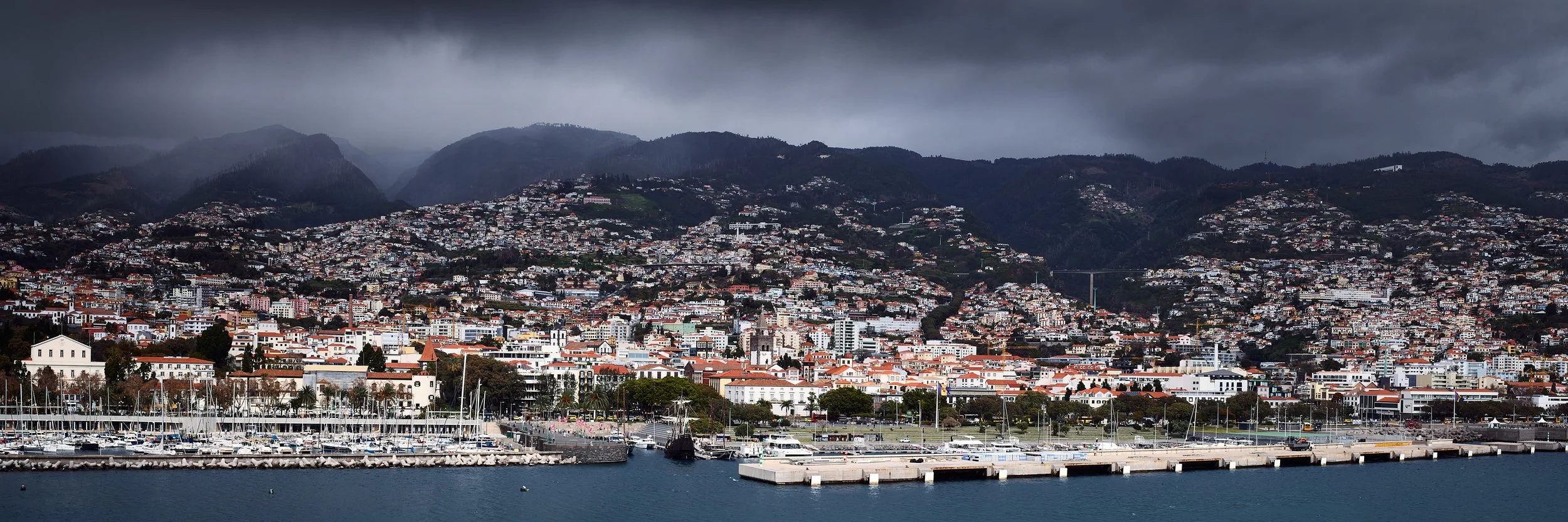
Funchal harbour panorama 2026 © Martin Urch
Madeira
Madeira, a Portuguese island linked to Britain through wine and treaties, was spared the full force of the Napoleonic continental blockade. It offered John Blandy something England could no longer offer: a future. His departure in 1808 was a calculated gamble born of limited options—an outward journey driven as much by quiet desperation as by ambition, and one that transformed a threatened livelihood into an entrepreneurial venture and a lasting legacy.
John probably left England’s shores not as a paying passenger, but as a participant. In an age when ships carried labour as readily as cargo, passage to Madeira could be earned through service—working as clerks, assistants, or trusted hands on a merchant vessel. The cost was modest, often covered by reputation or promise rather than money. A journey was funded through effort, skill, and the willingness to begin again.
Madeira lay directly on established Atlantic routes, and ships were already sailing there with provisions. Moreover, many of the powerful East India Company’s fast-sailing cutters victualled in Madeira, taking on water, vegetables, fruit, and wine cargo destined for India and England. Madeira’s fortified wine travelled well, strengthening on long sea voyages and finding eager markets across the British Empire.
As Europe descended into the chaos of the Napoleonic Wars, Madeira’s strategic position and British protection rendered it a rare bastion of relative stability. For John Blandy, it was an island where hardship could be exchanged for opportunity, and where enterprise, rather than birth, shaped his family’s future.
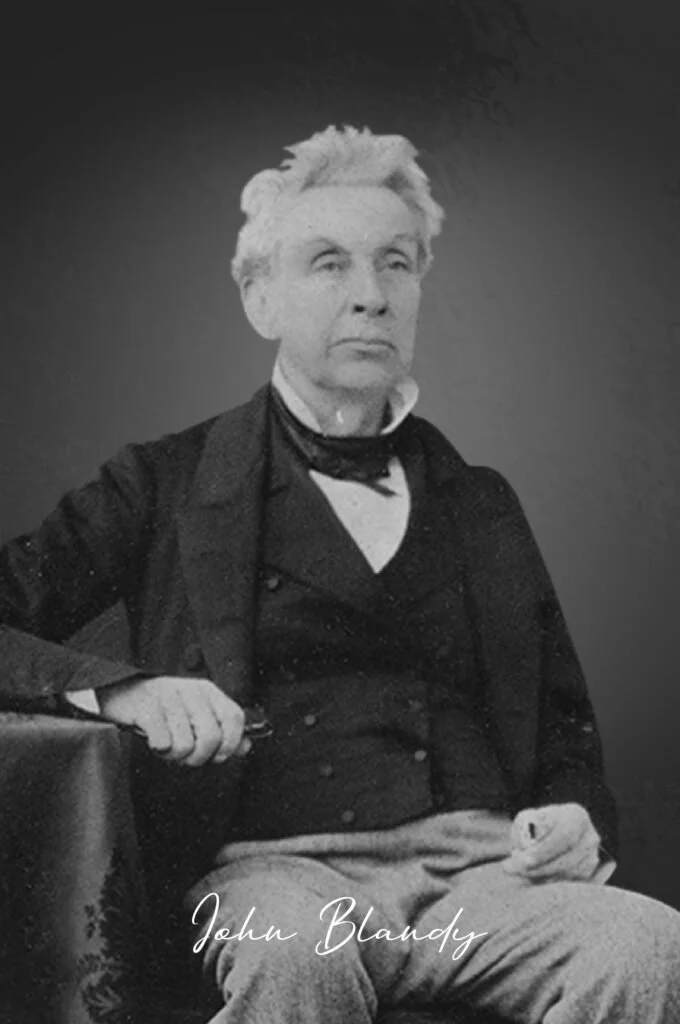
Image courtesy of Madeira Wine Company / Blandy’s Madeira – www.blandys.com
Foundations
John Blandy came to Madeira to work for a well-established wine merchant on an island poised between empire, ocean, and opportunity.
When he entered the counting house of Newton, Gordon, Murdoch & Scott, he stepped into a world governed by paper, ink, and meticulousness. The day would begin with morning twilight and stretch as long as vessels waiting to load or unload required attention. Tall stools, high desks, and ledgers filled with thick calf-bound pages comprised his immediate surroundings. Every transaction—whether pipes of wine sent to Philadelphia, freight charges to London, or advances to local growers—passed through his hand as figures to be set down neatly in ink.
It’s difficult to imagine in a computer age that there were no mechanical aids and no room for carelessness in 1808. Arithmetic was performed mentally or in rough columns before being entered into the ledger; a blot or mis-strike of the quill could leave a mark that might endure for decades. The discipline was strict: totals had to be carried forward, exchange rates calculated across different currencies, and correspondence copied neatly into letter books for dispatch on the next outward vessel.
As dusk fell, the work often continued. Candles were lit, their smoke and tallow scent mingling with the dryness of paper and dust. Under that flickering light, concentration needed to sharpen; shadows made figures harder to read, and fatigue increased the likelihood of errors—yet errors were precisely what could not be afforded. The counting house demanded a particular mental resilience: data stored in memory until it could be recorded, relationships between shipments and payments remembered across months, and trust maintained through accuracy.
In 1810, John briefly returned to England, where he married Janet Burden at St. Andrew’s, Holborn, and then sailed back to Madeira in 2011, accompanied by his wife and two younger brothers —Thomas and George — to build their reputations and fortunes. The brothers also carried with them the customs of provincial England: the quiet discipline of record-keeping, the importance placed on reputation, and the belief that credit was earned through behaviour as much as through wealth.
The family’s origins reassured merchants, captains, and buyers, while being distant from London freed them from rigid hierarchies. Capable of adapting, settling, and thinking beyond the short term, they bridged two worlds—bringing England’s measured customs into an island economy shaped by risk and trade, the Blandy brothers were prepared to take some calculated start-up risks.
They initially neglected to insure some sailing cargo to reduce costs and increase profits from their early sales. The business expanded rapidly, with 1812 documentary evidence of them internationally buying and selling numerous cargoes of flour, beef, pork, butter, lard, cheese, and candles, among other goods, in addition to their principal export of Madeira wine. They had established a sustainable position.
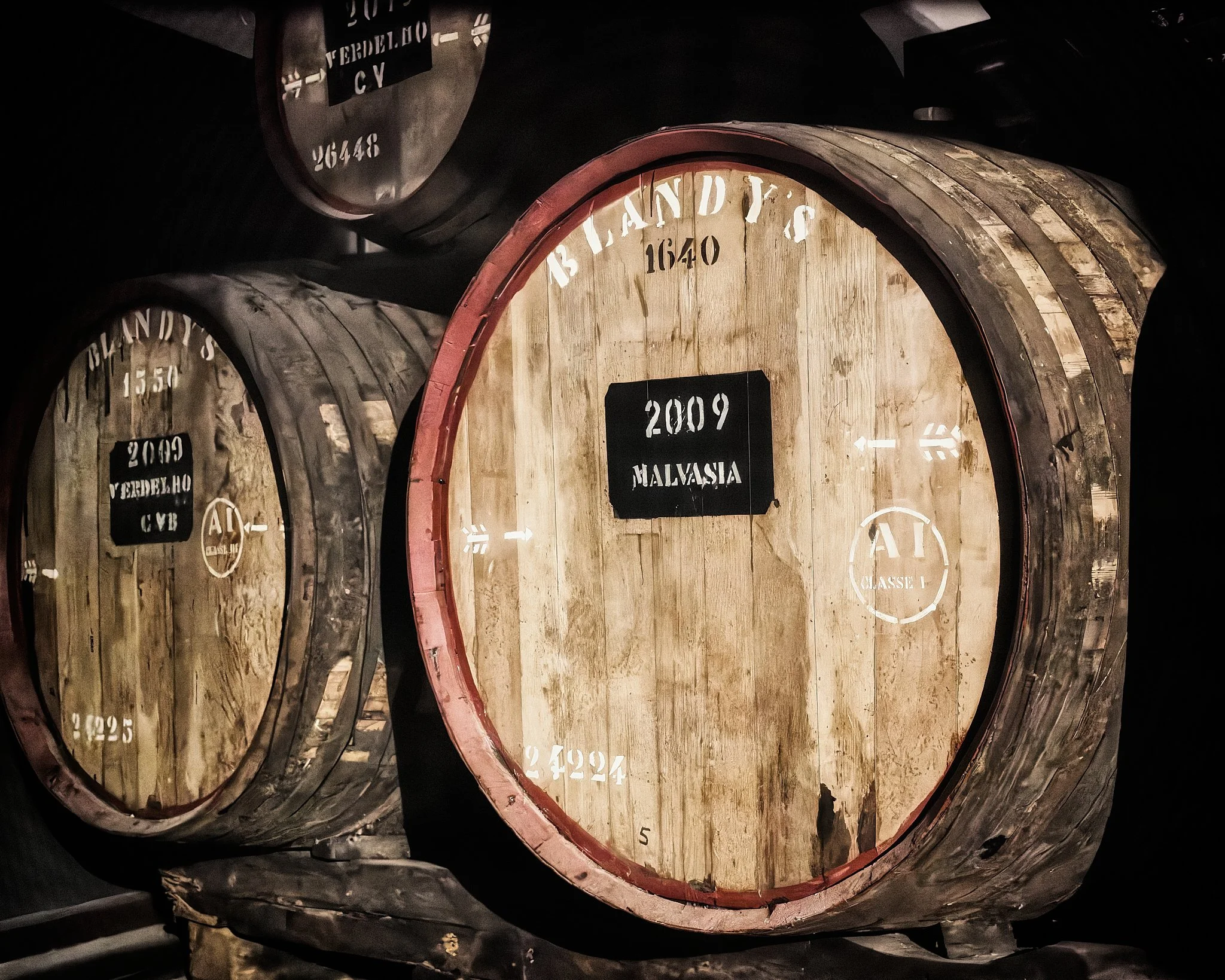
Wine maturation barrels, Blandys Wine Lodge © Martin Urch
Wine
What was it like to run an agricultural wine trade in the 1800s? Madeira has fertile soil that supports lush vegetation. It is nicknamed the “floating garden” because it formed from weathered basalts, volcanic ash, and lava flows that released essential nutrients. Yet it is one of the world’s most mountainous islands, with 70-80% of its surface covered by rugged, steep slopes, deep valleys, ridges, and gorges.
Before dawn, grape pickers climbed slopes to the vine terraces that rose in tight, stone-ribbed steps, each one carved by hand into the mountainside, each demanding balance and stamina. Wicker baskets were slung low against the hip; knives were short and sharp. The grapes—small, thick-skinned, sun-darkened by Atlantic glare—were taken bunch by bunch, fingers numbed by the cool morning air and then tanned by the sun as the day progressed.
There was no cart to lean on, no beast to carry the load. Everything moved by muscle alone: the basket filled, basket shouldered, and basket carried down perilous steps slick with dust and juice to nearby presses. By noon, their backs ached, palms were stained purple, and the air carried the sweet smell of crushed fruit and sweat. At the nearby stone trough, the work changed but did not soften. The grapes were tipped in, and the pickers climbed in after them.
Shoes were discarded; trousers were hitched up. Then came the treading—slow at first, almost ceremonial, as the fruit gently burst beneath the feet. As the skins split, warm juice seeped up around the ankles and then the calves. The pace quickened as men stood shoulder to shoulder, arms linked for support, stamping in rhythm, their feet slick and purple, each step extracting more colour, tannin, and sugar from the fruit.
This treading produced the must (the fresh mixture of juice, skins, seeds, and pulp), which was poured into goatskin bags and hauled down from the hills slung across shoulders, each man carrying a sturdy staff to steady his stance on the steep descent. In Funchal, after mechanical pressing, the juice was channelled into large wooden vats for fermentation. These too had been created and set without machines, tightened with iron hoops and sealed with cooperage expertise rather than by measurement.
The day’s labour ended with rinsed legs, stained hands, and aching bones, but the process continued unseen as the vats warmed and stirred, the wine beginning its long fermentation. In Blandy’s wine lodge of Funchal, every cask carried the memory of human endurance, and the simple fact that nothing in Madeira was ever made easily.
Family
John’s family grew alongside his prosperity. From thepeerage.com genealogical source, I discovered seven children survived to adulthood: Charles, born in 1812; Janet, born in 1814; Anne, born in 1815; Alice, born in 1816; Alfred, born in 1822; Frederick, born in 1824; and Elizabeth, born in 1826. I also sadly found five other children who died very young: Elizabeth (1811, died aged 2); John (1817, infant death); Charlotte (1818, died aged 5); Emma (1820, infant death); and John II (1828, infant death).
This life-and-death balance, brutal to modern eyes, was unremarkable in its own time. For families like the Blandys, infant death was an expectation kept at bay by hope. Survival was never taken for granted in the infant years; it was something watched for, day by day, breath by breath. To raise a child beyond infancy was a quiet triumph in a world where disease claimed many lives before they had properly begun.
I could not find the cause of death for the Blandy children, but fevers were the most feared visitors of the era. A child could be flushed and crying one hour, then limp and unresponsive the next. Scarlet fever and smallpox swept through households in waves, sparing some children while claiming others with ruthless efficiency. Measles was often fatal to infants, too: it drained the body’s strength, inflamed the lungs, and left the child vulnerable to pneumonia.
Whooping cough persisted longer and more cruelly. It exhausted infants over weeks, each violent spasm of coughing stealing the child’s breath, sleep, and nourishment. Parents held tiny bodies upright throughout the night and learned to recognise the sound indicating the lungs were losing the fight. Diseases of the gut were also deadly and common. A child could fade within days, skin slack, eyes dull, voice gone.
Like many women of the 1800s, Janet Burden’s marriage was more about repetition than certainty: conception, hope, endurance, loss. In the early nineteenth century, childbirth was not a single ordeal but a repeated gamble with fate, undertaken again and again because there was no other way to build a family or secure a future. Each pregnancy followed the same quiet calculation—who might survive, and who would almost certainly not.
Parents learned a particular kind of emotional discipline. Joy was genuine but provisional. For families like the Blandys, this randomness of life influenced everything. When there’s a chance that several of your children may not reach adolescence, the future is not planned—it’s grabbed where it can be. The same world that demanded resilience from those who cultivated Madeira’s vineyard terraces demanded it in the birthing chamber.
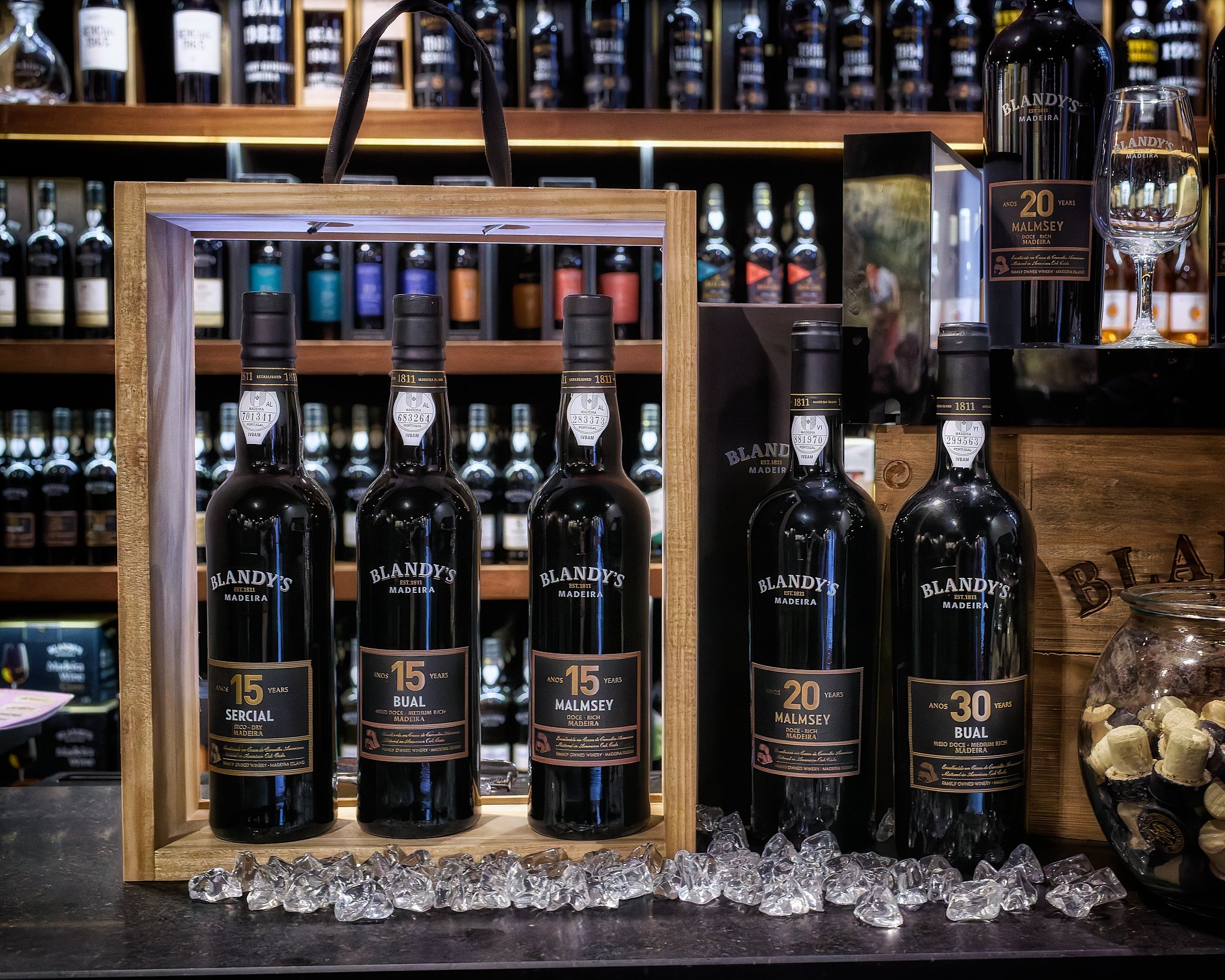
Blandy’s Wine Lodge — Tasting © Martin Urch
Fieldwork
My wife and I arrived by ship on a February morning in 2026 as dawn was breaking. Funchal was lit by thousands of streetlights, strung like pearls in zigzag patterns up the hillside, with cloud and mist enveloping the upper slopes in mystery. Electric lights were not installed in Funchal until 1897, and in 1808, the city had 13,500 residents. Jump ahead two centuries to neighbourhoods that stretch far beyond the old harbour. Funchal is eight times larger than when John lived and worked on the island. Yet the flora, geology and farmland can be imagined as he would have seen them.
On land, we drove along the winding roads of the south and north-facing slopes. Clothing layers shifted from T-shirts to jumpers and raincoats within minutes. Eight microclimates! A drive that revealed how labour-intensive agriculture still is today. Narrow steps are still cut into the slopes for farmland unsuitable for mechanisation. Grapes are picked in much the same way as when John established Blandy’s, still harvested by hand into heavy shoulder-carried baskets.
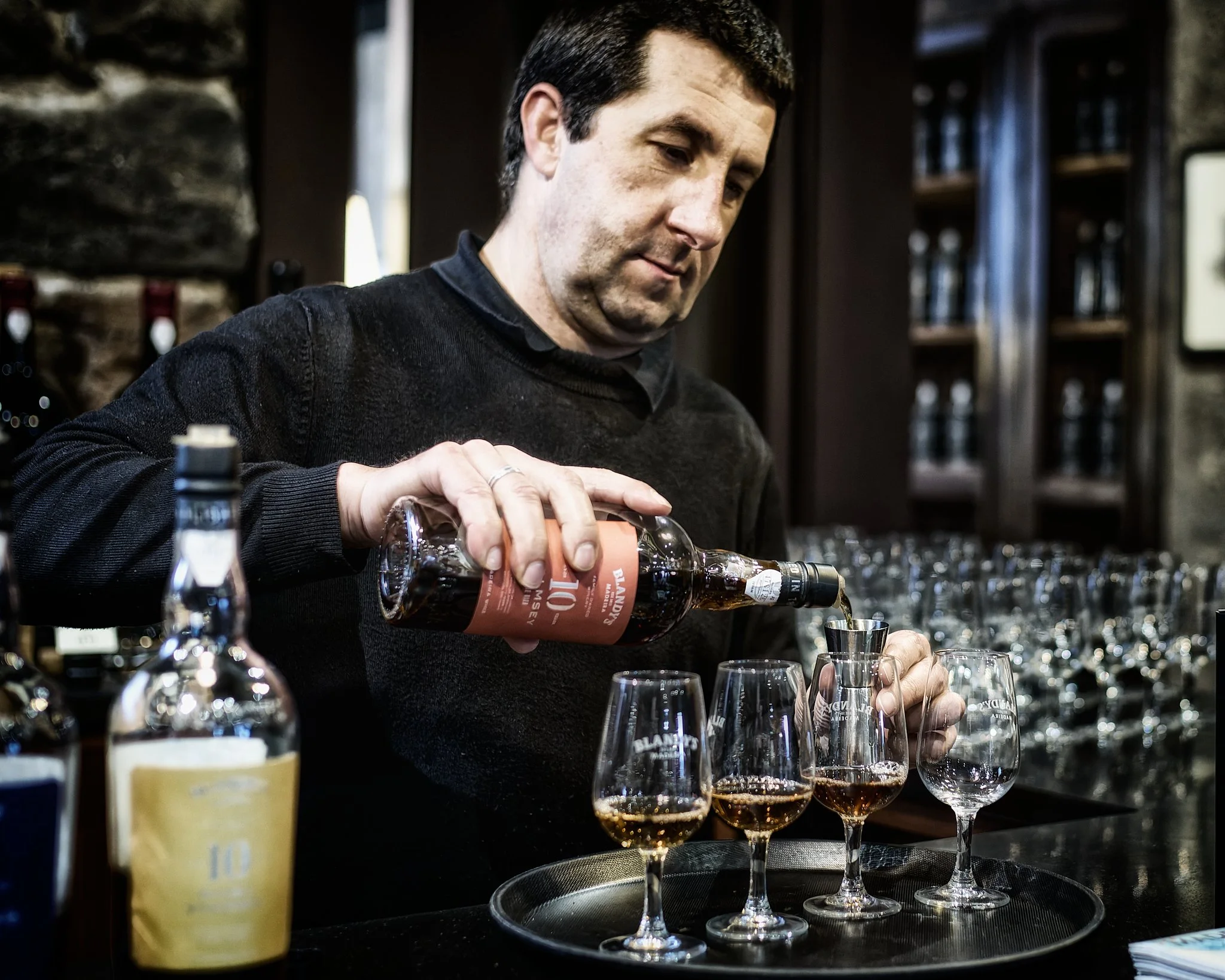
Blandys Wine Lodge — The Pouring © Martin Urch
In the afternoon, we visited Blandy’s Wine Lodge in Funchal, known locally as the ’wine cathedral’ for its extensive stocks of vintage wines. It’s a step back in time entering a flagstoned courtyard surrounded by charming, irregular buildings that serve as a living museum and house cellars filled with large, antique-looking wooden butts and maturation barrels. The aroma evoked centuries past, the air seasoned by the breath of wine and wood — wonderful. The tour concludes in a wood and leather-lined furniture tasting room, where else, and its remarkable vintage wine library — dust-covered bottles standing in place of books.
Epilogue
Over generations, the Blandys became inseparable from the story of Madeira wine itself. They did not invent it, but they refined it, protected it, and transported it around the world, turning a local tradition into an international emblem of quality and endurance. In the cool lodge, heavy with the scent of ageing barrels, time slowed, while beyond the island’s shores history continued—wars, markets, and empires rising and falling.
Stories gathered around the family known for resilience and keen judgement, and for their hospitality extended to statesmen and artists. These are not myths of magic or monsters covered in some of my writings, but the quieter folklore of perseverance, adaptability, and a long memory. This essay has traced the origins of legacy—where hardship turned into adventure, trade became tradition, and one family’s journey became part of Madeira’s enduring spirit.
By his death in 1855, John Blandy had established an international business with trade in England, Holland, Russia, the West Indies, and the Americas. In 1855, leadership of the business and considerable wealth were passed to his eldest son, Charles, marking the second-generation continuity of a dynasty that endures to this day.
Enquiries regarding book-length collaborations and extended narrative projects, including works developed in partnership with institutions or archive holders, are welcome.
Copyright
Martin Urch Photography owns the copyright to all writing and to all images marked © Martin Urch.
What Next
Six thousand years ago, the landscape of Britain changed forever. Our ancestors ceased their wandering and turned to the soil, marking a revolutionary shift that marked the beginning of modern human behaviour.
But for the Neolithic builders of Avebury, farming was never just about calories. In my next essay, I explore:
The Dawn of Farming: How the domestication of plants and animals at Avebury triggered a turning point in our history.
The Architecture of Belief: Why these early farmers built colossal, astronomically aligned monuments that still pulse with meaning today.
The Living Ritual: Fieldwork photography around the modern Druid Spring ceremonies that continue earth-honouring spiritualities of our past.
As the Spring sun aligns with the ancient megaliths of the world’s largest stone circle, I will be documenting the ceremonies that bridge the gap between the first harvest and the modern seeker.