Inside Iron Age Minds: Why We Still Gather Around the Fire
Celtic life, seasonal ritual, and the enduring power of renewal
This essay is distilled from a chapter of Inside Minds: The Long Memory of Britain, a developing narrative history book bringing Britain’s heritage to life through historical research, original fieldwork, and documentary photography. Each chapter uses immersive storytelling to explore past beliefs, rituals, and institutions, and to trace their enduring influence into the present.
In this shorter essay, I focus on the historical question, fieldwork, and evidence to present the central argument emerging from my research into Iron Age seasonal belief and Edinburgh’s modern Beltane Fire Festival. I hope it provides an enlightening introduction to the discoveries and ideas that I explore more fully in the book.

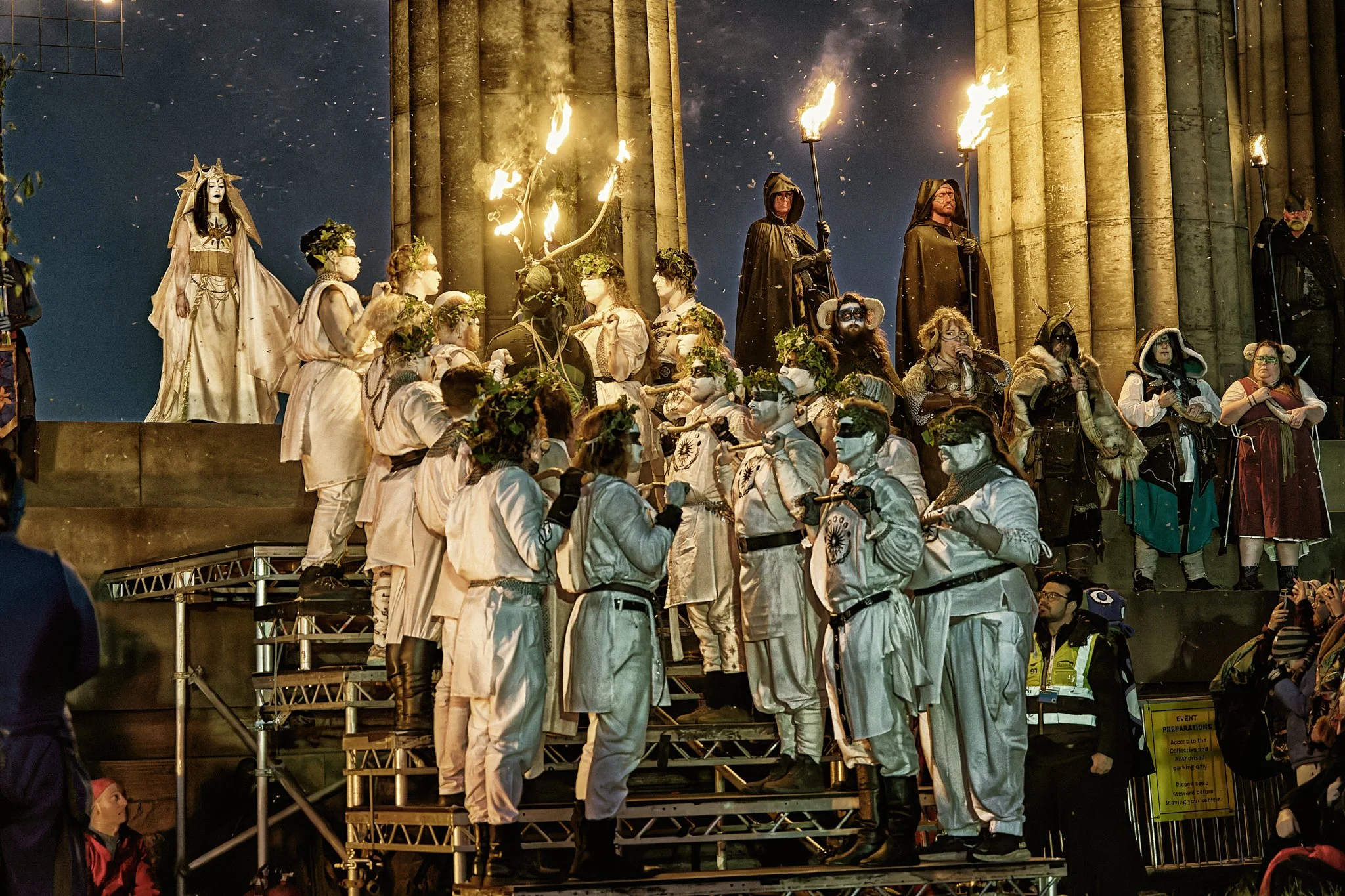
The Winter Green Man ascends to the May Queen at the beginning of Beltane, Edinburgh 2026 ©Martin Urch
Introduction
I journey to the last Celtic frontier that stood against the Roman Empire. My fieldwork takes me north of Hadrian’s Wall into the ancient land of the Picti—the ‘painted ones’—where each Spring the night sky above Edinburgh’s Calton Hill erupts in the roaring fires of Beltane
Long before Edinburgh became a city, communities north of the frontier later marked by Hadrian’s Wall lived by rhythms very different from our own.
Their survival depended upon land, livestock, kinship and the changing seasons. Farming required cooperation. Craft skills transformed iron and bronze into tools, weapons and symbols of status. Knowledge was carried through memory and oral tradition. Beyond everyday labour lay beliefs that connected human life with the natural world.
Among the most important moments were the seasonal transitions.
Beltane, associated with the beginning of summer, became one of the great seasonal festivals of the Celtic world. Fire lay at its heart. Livestock could be driven between fires or through smoke in rituals associated with purification and protection before summer grazing. The transition from winter into the fertile months ahead was not merely a change in weather. For agricultural communities, it represented survival, uncertainty and renewal.
Those Iron Age societies left us no direct written account of what they thought as they watched the seasons change. Archaeology and later historical sources provide fragments from which their world can be explored, but the inner meaning of their rituals can never be recovered with certainty.
Yet on the evening of 30 April each year, thousands of people still climb Edinburgh’s Calton Hill to gather around fire.
The modern Beltane Fire Festival does not claim to be an unchanged Iron Age ceremony.
So what, if anything, survives?
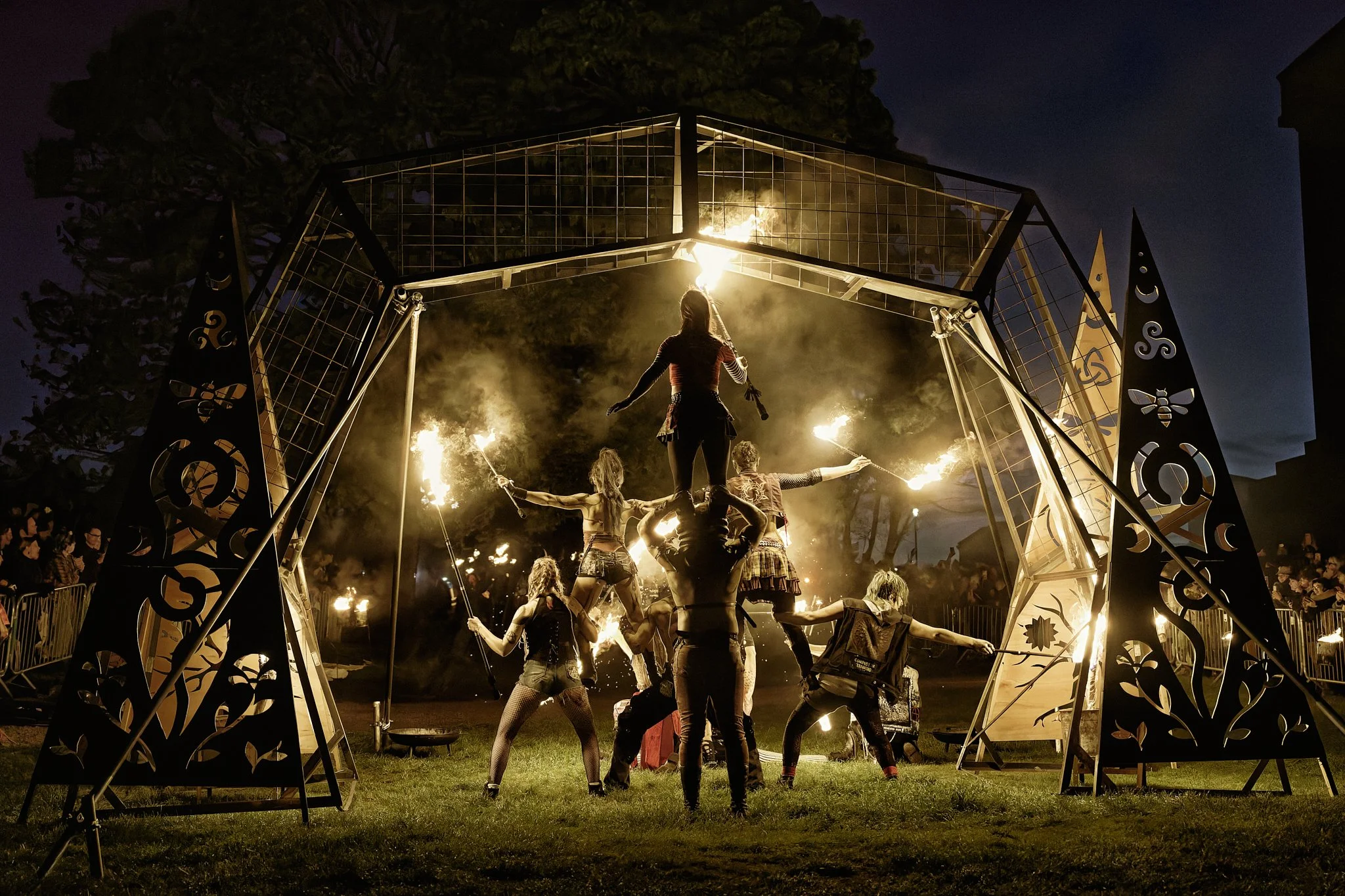
Team ‘Firearchy’ lighting the purification Arch. Beltane, Edinburgh 2026 ©Martin Urch
Fieldwork
Looking for continuity without claiming survival
On the evening of 30 April 2026, I stood among the gathering crowd on Calton Hill, camera ready, waiting for the first sparks to rise into the dusk.
I had come looking for something more difficult to photograph than fire.
The festival is a modern performance inspired by older seasonal traditions. Its May Queen, Green Man, Blue Men, Red Men and other performers inhabit a deliberately created ritual world of colour, movement, fire and theatrical storytelling.
To describe what happens there as an Iron Age ceremony surviving intact would be historically unsustainable.
But continuity does not always require an unchanged ceremony.
Could the modern festival preserve something deeper: familiar human responses to seasonal transition, uncertainty, fertility, community and renewal?
As darkness gathered over Edinburgh, three moments became particularly revealing.
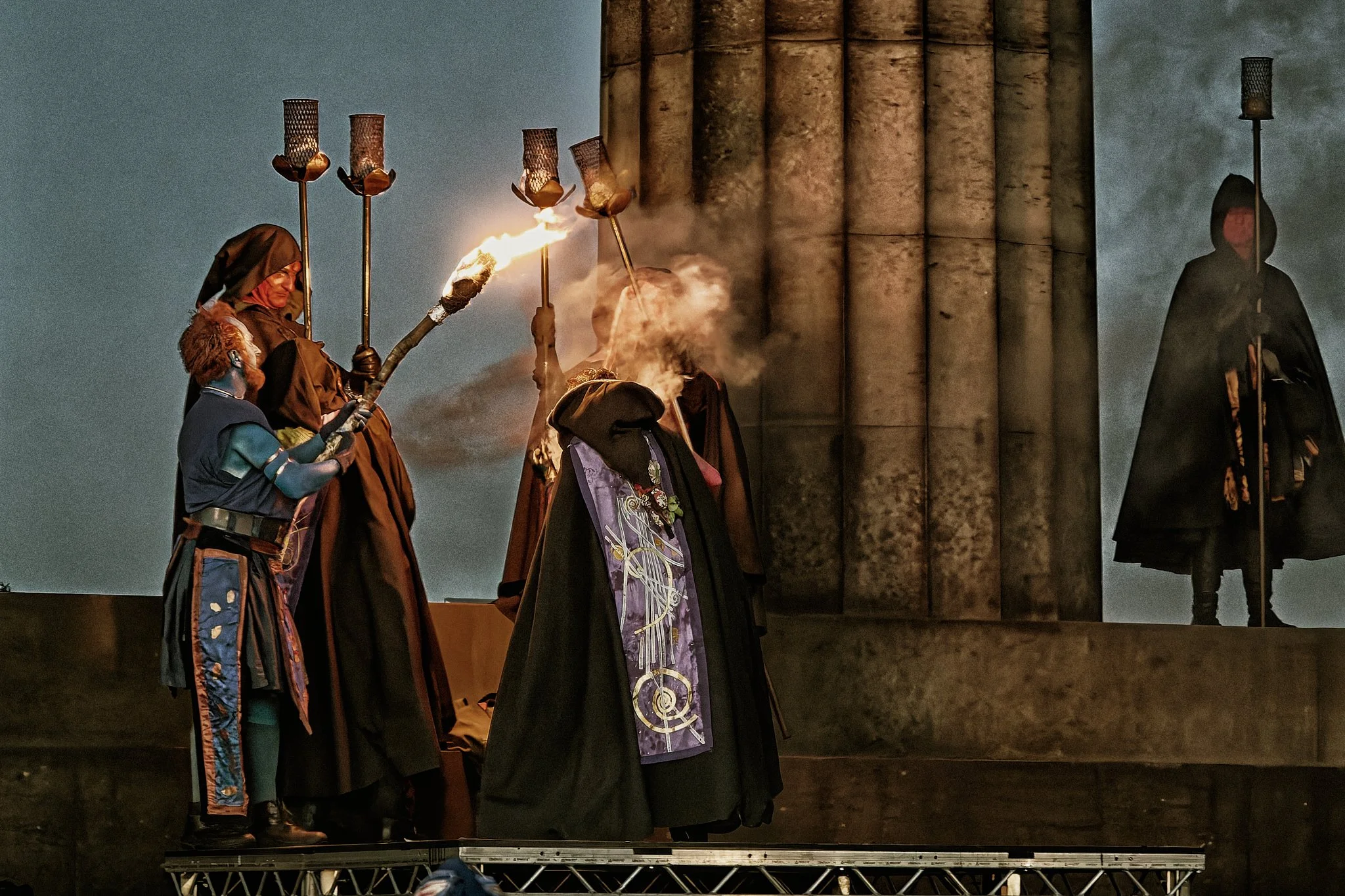
No flame is taken into Beltane. This is the first fire made from friction alone. Beltane, Edinburgh 2026 ©Martin Urch
Fire made anew
Before the torches flare and Calton Hill fills with fire, something much quieter happens.
No flame is carried into Beltane.
At the Acropolis, fire is created from friction. Hands work patiently against wood until heat becomes smoke, smoke produces an ember, and the ember is coaxed into flame.
From that single new fire, the first torch is lit. From there, fire spreads across the hill.
Watching it happen revealed something fundamental about the night.
Fire is not merely illumination or spectacle. It marks transformation.
For ancient agricultural communities, fire could carry equally powerful meanings. It provided warmth and protection, transformed materials, cleared land and formed part of seasonal rituals associated with livestock, fertility and purification.
The modern ceremony belongs to a very different world, yet the symbolism remains immediately comprehensible.
Something ends. Something is created. The flame is passed onwards.
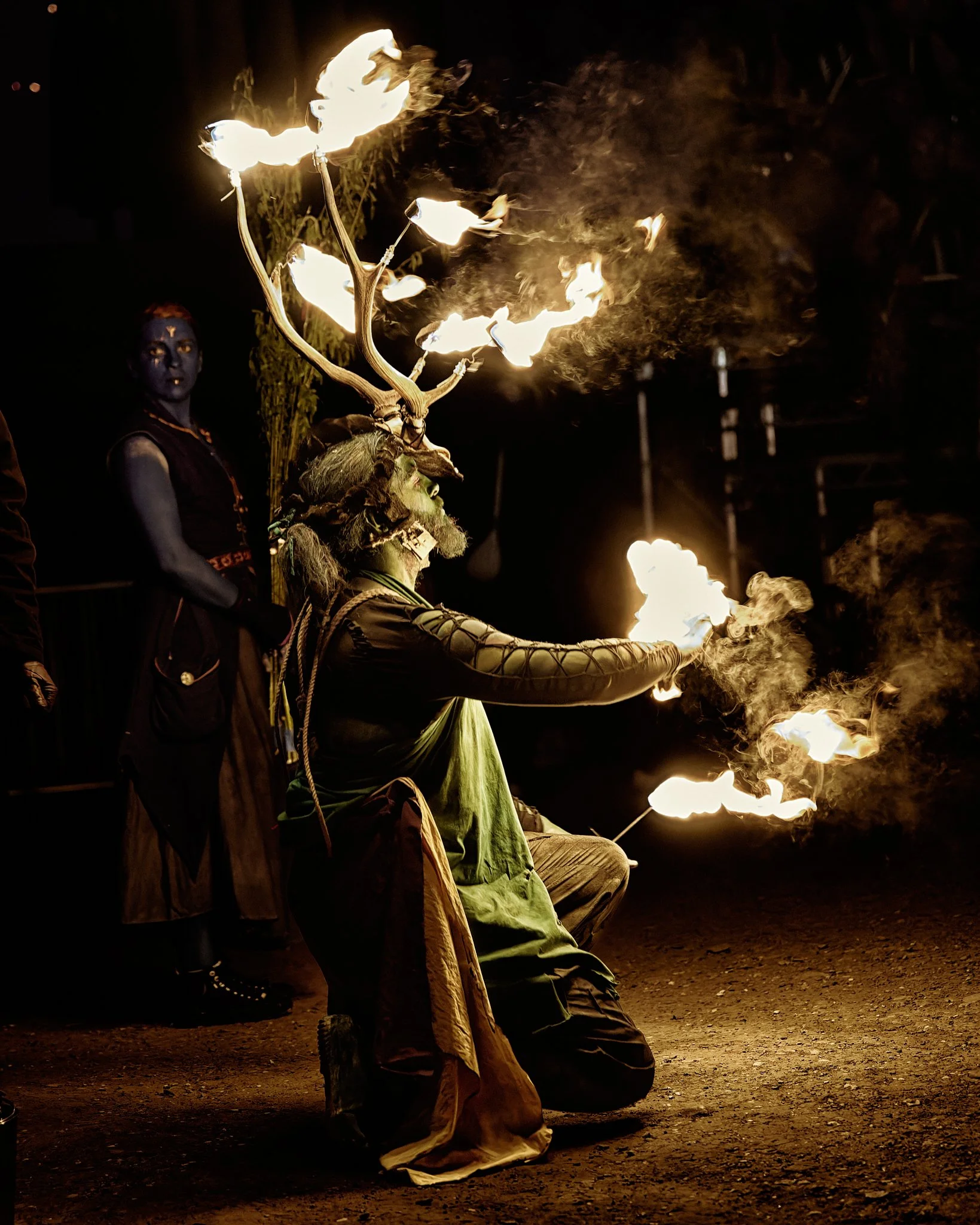
The Winter Green Man must burn for the Summer Green Man to be reborn. Beltane, Edinburgh 2026 ©Martin Urch
Winter must give way
The May Queen rises from her winter slumber while the Winter Green Man approaches, burdened by the season that is ending.
He is rejected.
What follows is a journey around the hill through fire, movement, confrontation and transformation. The Winter Green Man must give way before the Summer Green Man can emerge.
For people whose survival depended directly upon agriculture and livestock, the transition from winter to summer carried consequences that are difficult to appreciate from the relative security of modern life. Stored food diminished. Livestock remained vulnerable. Fields awaited cultivation. The promise of warmer months brought opportunity, but never certainty.
Modern Beltane turns that transition into theatre.
Winter and summer become characters. Dormancy and fertility acquire bodies. The anxiety and hope associated with seasonal change become something a crowd can see, hear and experience together.
The details are modern.
The underlying human response is much older.

The May Queen leads her procession through the flaming purification archway. Beltane, Edinburgh 2026 ©Martin Urch
Through fire together
The procession eventually reaches a flaming archway.
The May Queen passes through the cleansing fire and smoke, leading her followers onwards around the hill.
Here the visual connection with older Beltane traditions is especially powerful. Historical traditions associated with the festival describe livestock being driven between fires or through smoke for protection as they moved towards summer grazing.
Nobody on Calton Hill is recreating that agricultural necessity.
Instead, people themselves move through a symbolic landscape of purification and transition.
And they do it collectively.
That mattered.
Throughout the evening, thousands of strangers became an audience to the same sequence of events. Performers created order, disrupted it, restored it and finally gathered around the festival’s culminating images of fertility and renewal.
The experience suggested that the persistence of seasonal ritual may depend upon something more fundamental than belief in any particular ancient deity or ceremony.
Humans still use shared ritual to give meaning to change.

The Summer Green Man is crowned by the May Queen. Beltane, Edinburgh 2026 ©Martin Urch
Conclusion
The discovery
By the end of the night, the question that had brought me to Calton Hill had changed.
I was no longer asking whether modern Beltane preserved an ancient Celtic ceremony.
It does not need to.
What survives is more subtle.
The fires on the hill reveal how persistent certain human responses remain: our awareness of seasonal transition, our desire to gather at moments of change, our use of ritual to create communal meaning, and our instinct to turn destruction and uncertainty into stories of renewal.
Iron Age societies understood these things in a world in which survival depended directly on land, livestock, kin, and the seasons. Fire cleansed and protected. Kinship distributed responsibility. Seasonal gatherings reinforced the bonds upon which communities depended.
Our circumstances have changed almost beyond recognition.
The patterns have not entirely disappeared.
Modern Beltane takes ancient ideas and consciously reimagines them. The fire is theatrical rather than agricultural. The performers assume created identities. The crowd comes to witness rather than to protect cattle before summer grazing.
Yet thousands still climb a hill as winter gives way to summer. A new flame is created. People gather around it. Winter is symbolically surrendered. Fertility and renewal are celebrated. A community, however temporary, forms around shared ritual.
That is where I found the continuity I had been looking for.
Not in an unbroken ceremony handed intact from the Iron Age to the twenty-first century, but in something more enduring: the human need to give meaning to the turning points of life and nature.
The past does not have to survive unchanged to remain influential.
Sometimes its deepest inheritance lies in patterns of behaviour whose origins we no longer consciously remember.
On Calton Hill, fire still gathers people together.
And when the flames rise into the Edinburgh night, an ancient idea becomes understandable again:
renewal requires us to let something go first.

The beloved May Queen, followed by the Winter Green Man and her attendant protectors. Beltane, Edinburgh 2026 ©Martin Urch
Experience Edinburgh Beltane
Edinburgh’s Beltane Fire Festival is not an archaeological reconstruction of an ancient Celtic ceremony. That is precisely why it is worth experiencing. Stand on Calton Hill as darkness falls, watch fire spread from a single newly created flame, and follow the procession through its stories of winter, purification, fertility and renewal. It offers a rare opportunity to consider how ancient patterns of seasonal thought can be reimagined by a modern community—and why, thousands of years later, we still gather around fire.
Sources
Beltane Fire Society, Edinburgh
The Picts — Tim Clarkson
Pagan Britain — Ronald Hutton
Blood and Mistletoe — Ronald Hutton
Scotland’s Sacred Past — Freddy Silva
The Book of Druidry — Kristopher Hughes
Enquiries
Enquiries regarding book-length collaborations and extended narrative projects, including works developed in partnership with institutions or archive holders, are welcome.
If you enjoy my work, you can even consider throwing a few pennies into the tip jar. Click the ‘buy me a coffee’ button to help fund my research and writing. Until next time…

What next?
Inside Medieval Minds: Knights, Faith, and the Discipline of Service is the next step in this journey—a move into a world where belief was not abstract, but lived through rule, ritual, and action. This chapter will explore the extraordinary mindset of the medieval military orders, in which the knight was no longer an individual hero but part of a disciplined brotherhood bound by vows of poverty, chastity, and obedience. From the legacy of the Knights Hospitaller to the enduring myths of the Knights Templar, the story will trace how faith and warfare fused into a single purpose: protecting others as an act of devotion.
But this will not be a story confined to the past. As with Avebury Equinox and Edinburgh Beltane, the search is for continuity—for the places, people, and moments where the ancestral mind still breathes. From ancient institutions that continue their charitable mission to modern volunteers who embody the same ethos of service, this next instalment will reveal how the warrior-monk has not disappeared but has evolved. Expect a journey through living traditions, powerful symbolism, and human stories that collapse the distance between centuries, where the values that once shaped crusader knights can still be found, quietly at work, in the present day.
Copyright
Martin Urch Photography owns the copyright to all writing and images
Rights & Reuse
Reuse may be considered on a non-exclusive, fully credited basis, with copyright retained.