Inside Medieval Minds: The Warrior-Monks Who Never Disappeared
Medieval hospitality and service, rule and lived discipline.
A narrative grounded in medieval history and fieldwork. Through the Brothers of the Hospital of Saint Cross, explore a medieval world where faith, duty, charity, and communal service shaped identity itself.
Medieval England was a world suspended between violence and salvation. Kingdoms fractured through dynastic ambition, famine shadowed the harvests, and ordinary lives were shaped by forces believed to originate equally from earthly rulers and divine will. Yet amid this uncertainty, institutions arose that sought to impose order upon chaos — monasteries, hospitals, churches, and brotherhoods governed by ritual, discipline, and acts of charity.
At the centre of this story stands the Hospital of Saint Cross in Winchester: a medieval institution founded during the turmoil of The Anarchy, where prayer, food, duty, and routine became instruments of stability in a shattered realm. Through narrative history, fieldwork, and photography, this Inside Minds explores how medieval people understood power, suffering, salvation, and communal responsibility—and how echoes of those beliefs persist in Britain’s cultural memory today.
To enter Saint Cross in the twelfth century was to step into a world where charity was sacred, obedience was survival, and the salvation of the soul shaped every hour of the day.
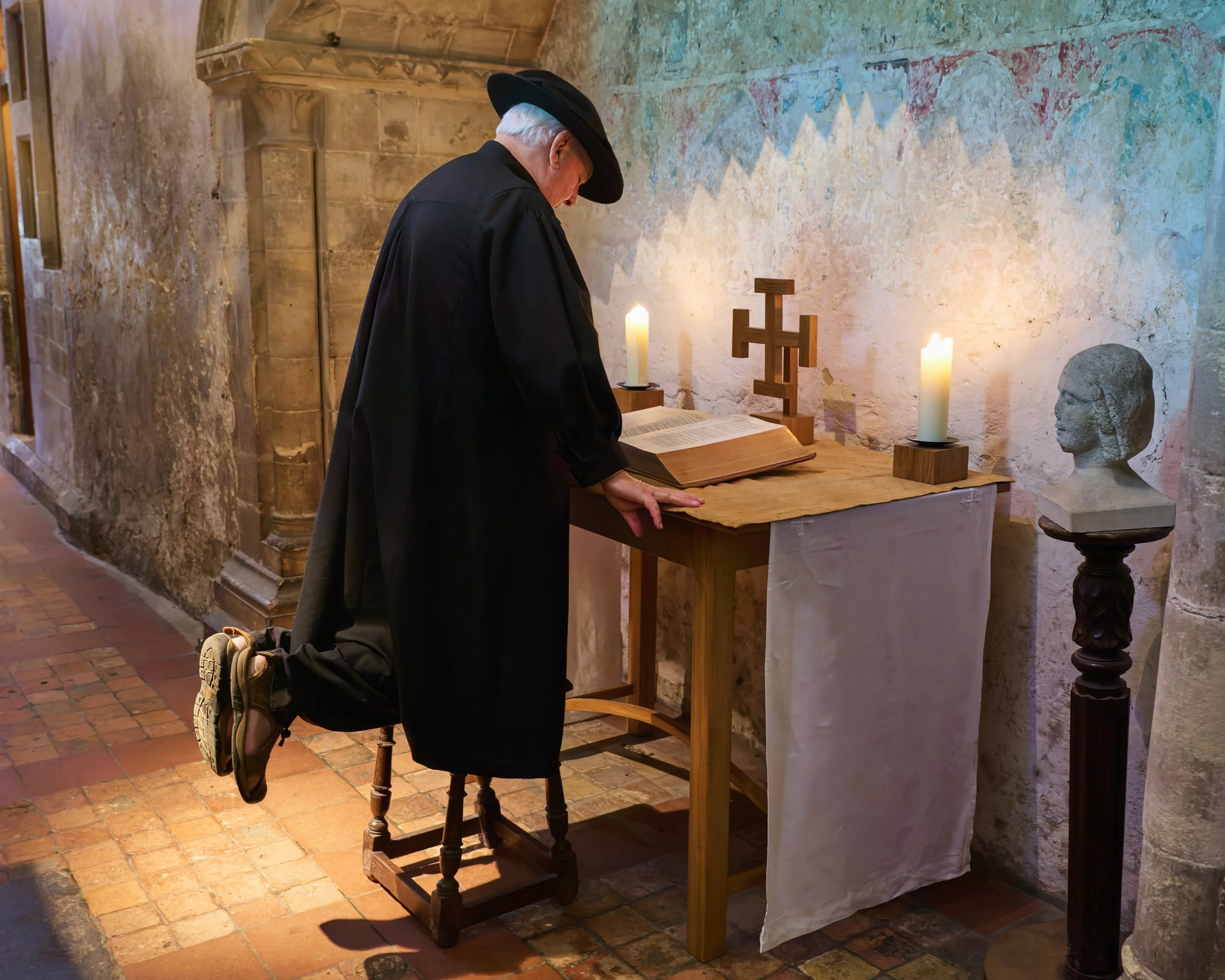
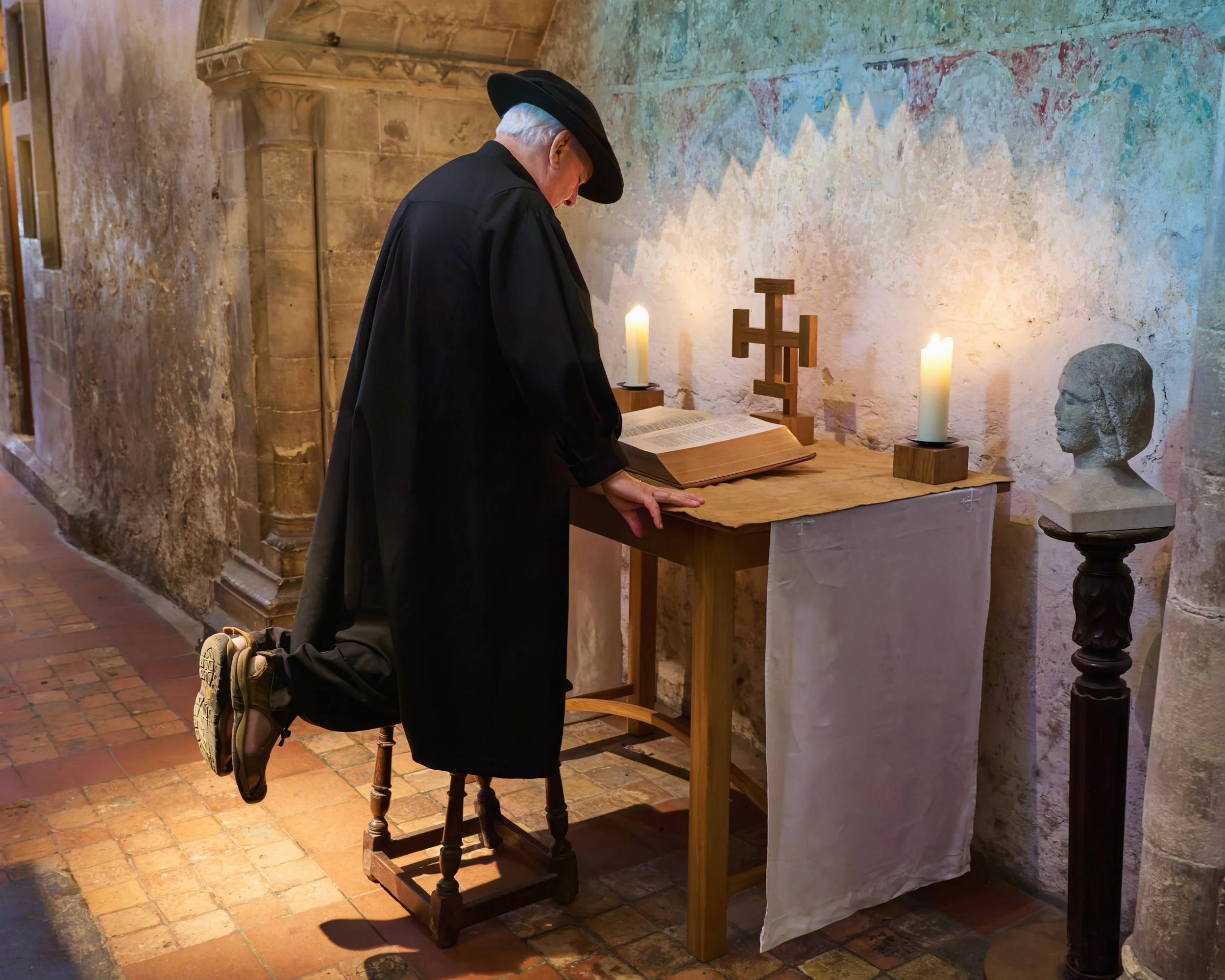
Faded medieval wall paintings provide later layers of devotion within a space shaped by centuries of prayer. © Martin Urch
Setting the Scene: Faith and Power in a Fractured Kingdom
When King Henry I died in the winter of 1135, the stability forged by his father, William the Conqueror, began to fracture almost immediately. Across England, powerful nobles weighed loyalty against opportunity as rival claims to the throne threatened the fragile order that Norman rule had imposed upon the kingdom.
Henry of Blois: Founder of the Hospital of Saint Cross
Among the royal bloodline stood Henry of Blois, grandson of William the Conqueror and brother of the future King Stephen. His father, Stephen-Henry, Count of Blois, had ridden east on the First Crusade, while his mother, Adela of Normandy, daughter of the Conqueror, governed the County of Blois during his absence and after his death in 1102. Intelligent, politically astute, and deeply committed to the Church, Adela helped shape the worldview of the son who would later found Saint Cross.
Yet Henry’s early life was shaped less by battlefields than by monasteries. At the age of two or three, he was sent to the great Abbey of Cluny in Burgundy, the spiritual centre of one of medieval Europe’s most influential monastic movements. There, life was governed by prayer, ritual, study, and discipline. Bells regulated the day, worship structured the hours, and obedience bound the community together. Henry absorbed not only the theology of the Church but also an enduring belief that order could be created through routine, ritual, and shared purpose.
The lessons of Cluny never left him. Contemporary chronicler Henry of Huntingdon famously described Henry of Blois as “part monk, part knight,” a phrase that captured the duality at the centre of his character. Though ordained to holy office, he retained the instincts of the Norman aristocracy: ambition, political agility, and an acute understanding of power. As Bishop of Winchester and later Papal Legate, he moved easily between cloister and court, combining monastic discipline with the authority of a statesman.
The Anarchy: The Death of King Henry I
The kingdom Henry inherited was descending into crisis. Henry I’s only legitimate son had drowned years earlier in the wreck of the White Ship, leaving the succession uncertain. Although the king named his daughter, Empress Matilda, as heir, many Norman barons resisted the prospect of a female ruler. Following Henry I’s death, Stephen seized the throne, and England slid into the civil war later known as The Anarchy.
Contemporary chroniclers described a kingdom where “Christ and His saints slept.” Castles multiplied across the landscape. Armed retainers extorted and plundered villages. Trade faltered, harvests failed, and ordinary people bore the consequences. Around Winchester, hungry travellers, displaced peasants, and the poor gathered along roads and church gates seeking food, shelter, and protection.
At the centre of this turmoil stood Henry of Blois. As Bishop of Winchester and Papal Legate, he wielded extraordinary influence over both church and state. Yet his position pulled him in opposing directions. As a churchman, he was expected to preserve peace and protect the vulnerable. As brother to King Stephen, loyalty bound him to the survival of his family’s rule. In him, the contradictions of the age became visible: piety beside ambition, charity beside calculation, sacred duty entangled with dynastic survival.
The Hospital of Saint Cross: Foundation and Purpose
It was amid this atmosphere of uncertainty that the Hospital of Saint Cross emerged. According to later tradition, Henry’s inspiration came from encountering a starving child during the Civil War. Whether literally true or symbolic memory, the story captures the purpose of the institution he founded. Saint Cross was conceived not merely as an act of charity, but as a structure against disorder itself: a place where the poor would be fed, travellers sheltered, prayers maintained, and stability preserved despite the chaos beyond its gates.
Within its walls, routine replaced uncertainty. Resident Brothers lived within a disciplined religious community where food, prayer, duty, and salvation were woven together into daily life. By 1152, Henry of Blois had placed Saint Cross under the administration of Raymond du Puy and the Hospital of St John of Jerusalem, better known as the Knights Hospitaller, a religious order of warrior-monks whose mission united prayer, discipline, and the care of pilgrims in the Holy Land.
The Hospital of Saint Cross was far more than a refuge for thirteen poor men. Around its chapel and hall revolved a substantial community of clergy, servants, craftsmen, and labourers whose combined efforts sustained the foundation’s daily life. Chaplains maintained worship, clerks and choristers filled the church with prayer and song, while bakers, brewers, cooks, grooms, and carters ensured that hospitality never ceased. Whether Master, Brother, servant, or labourer, all were expected to participate in the daily rhythm of prayer. Here, bells regulated the hours, worship united the community, and charity was organised rather than sporadic. It was into this disciplined and ordered world that the Feast of the Finding of the True Cross dawned on 3 May 1152.
A Feast Day at Saint Cross: The 3rd of May 1152
The following narrative blends historical research with fictionalised scenes and dialogue to evoke the lived experience of medieval England. It is set at the Hospital of Saint Cross on the Feast Day of 3 May 1152, during the mastership of Robert de Limosia, who appears in surviving records between c.1150 and 1167.
In the Hospital of Saint Cross, men surrendered not only comfort but also ambition and identity to a sacred order. The prayers continued exactly as they had the day before and would continue again tomorrow. Outside the chapel walls, England fractured beneath rival monarchs.
The cold woke Robert de Limosia before the bells did. In the darkness of the Master’s chamber within the Hospital of Saint Cross, his breath drifted pale above the straw-filled pallet on which he slept. The coarse wool blanket covering him held little warmth against the lingering chill of early May. Beyond the shuttered opening, the meadows south of Winchester lay hidden beneath mist and darkness, while somewhere beyond them, England endured another year of uncertainty and fractured rule. Robert sat upright slowly and crossed himself before his feet touched the rush-strewn floor.
Beside the bed lay the garments of his office folded with habitual care. First came the rough linen shirt, scratchy against the skin and carrying the faint smell of candle smoke. Then the heavy wool tunic, belted at the waist with plain leather. Thick woollen hose were tied about his legs against the cold, followed by simple leather shoes stiffened by rain and mud. Last came the black hooded robe of Saint Cross itself, weathered and severe, bearing the pale Jerusalem cross associated with the wider discipline of the Knights Hospitaller. Nothing in the chamber spoke of comfort or personal possession. The Master owned little because the institution demanded little self-ownership. Beyond these walls, men fought to secure crowns and lands. Within them, life was measured instead by prayer, obedience, and service.
July 2026. Daily Matins begins with the 10 am bells © Martin Urch
Then the bells began. Their iron voices rolled through darkness across brethren’s quarters, churchyard, and meadow alike, summoning every man within Saint Cross to the same duty. No Brother governed his own hours here; the bell governed all alike. Candles stirred to life one by one beneath the stone passages as hooded figures emerged silently from their chambers. Robert joined the procession and entered the chapel for Lauds. Inside, the Norman nave, the smell of cold stone, incense, and damp wool filled the air. Brothers bowed in sequence before taking their places within the stalls, black robes rendering them nearly indistinguishable from one another beneath lowered hoods. Chanting began in measured Latin responses rising and falling in disciplined rhythm beneath the thatched roof, with Robert’s voice joining the collective.
By the third hour of the morning, prayer gave way to governance. The hospital moved according to routine, as carefully ordered as worship. Robert crossed into the kitchen ranges where servants already laboured before roaring hearths. Cauldrons steamed above suspended chains while spits turned slowly over open flames, filling the room with the scent of roasting pork and woodsmoke. Today was no ordinary feast day. Throughout Christendom, the third day of May commemorated the Finding of the True Cross by Saint Helena, mother of the Emperor Constantine. Feast days required proper provision. Bread was counted carefully. Ale barrels inspected. Salt stores checked against expected use. Kitchen waste or disorder threatened the institution’s stability.
From there, Robert entered the counting chamber where parchments, wax tablets, and account tallies covered a long oak table. A tenant disputed grain levies following flood damage along the Itchen. A steward reported that repairs were required to a boundary wall. Another servant stood accused of stealing lamp oil for sale within Winchester. Robert listened patiently, weighing each matter not as a personal grievance but as a disruption to order itself. The Hospital of Saint Cross fed people experiencing poverty, sheltered Brothers, maintained estates, and upheld sacred obligations during years when royal authority had weakened.
As Robert crossed the courtyard towards the gatehouse, his thoughts drifted briefly beyond the hospital walls. Nearly seventeen years had passed since King Stephen seized the throne, yet uncertainty still lingered across the kingdom. Oaths had been sworn and broken. Castles had risen where none had stood before. Reports carried by travellers spoke of roads made dangerous by theft, extortion, and rival loyalties. Though Winchester remained one of the kingdom’s great cities, the consequences of civil war arrived daily at Saint Cross in the faces of strangers seeking food, shelter, and relief. Whatever disputes divided kings, bishops, and nobles, the hospital’s duty remained unchanged.
Near the eleventh hour, the gates were opened to feed the hundred poor men. They had gathered long beforehand outside the precinct walls: bent old labourers, widows’ sons, wandering pilgrims, discharged soldiers, and peasants displaced by years of failed harvests and lawless roads. Their patched cloaks hung damp from morning mist, and many carried the hollow look of men long accustomed to hunger. Robert stood beneath the gate arch while servants distributed coarse bread and hot pottage into waiting hands.
A gaunt man stepped forward, clutching his portion carefully. “God preserve this place,” he murmured. Robert looked over the gathered faces displaced by a kingdom that no longer protected them. “While Saint Cross stands, no hungry man shall be turned from its gates,” he said quietly.
The bell began sounding again for the principal meal of the day. The Brothers assembled within the hall beneath smoke-darkened rafters while servants carried platters along the trestle tables. Feast day fare brought rare abundance: roasted pork seasoned with herbs, cabbage and leeks softened in broth, beans, coarse trenchers of bread, and ale poured into wooden cups. Yet even here, discipline governed appetite. The Brothers sat in ordered silence while Robert read aloud from scripture against the crackle of hearth fires.
When the meal concluded, benches scraped softly across the floor as the entire hall rose in unison for Sext prayers, and the procession returned to the chapel. Robert gathered the Brothers within the cool stone nave, where silence settled. The scent of wax and incense lingered faintly in the air as daylight filtered through the narrow windows. The Brothers knelt together while the Master’s voice echoed softly through the nave. Robert bowed his head. Beyond these walls, England remained divided by war and uncertainty. Yet here the rhythm of prayer continued as it had yesterday and would continue tomorrow. The hospital’s purpose remained unchanged: to serve Christ in the poor and preserve a fragment of stability within a fractured kingdom.
When the prayers ended, no one spoke immediately. The silence itself seemed part of the observance. At last, an elderly Brother rose slowly from his knees and looked towards the altar. Robert followed his gaze. The feast honoured the long-ago discovery of the Holy Cross, yet its meaning lived not in relics or ceremonies alone. It lived on shared bread, given shelter, and lives ordered towards service. As the Brothers filed quietly from the church, Robert felt renewed in the conviction that had drawn him to this place. “The Cross is carried not only upon wood, stone or silver,” he thought, “but in the works of mercy entrusted to our hands.”
As the afternoon waned, Robert resumed the quieter oversight duties on which the institution depended. He walked to the infirmary where elderly Brothers rested beneath rough wool blankets while servants replaced straw bedding and carried water from the conduit. One man struggled with a winter cough that had never fully left him; another’s legs no longer supported his weight. Knights Hospitaller tradition demanded not merely shelter but disciplined care, cleanliness, nourishment, and dignity. Robert inspected stores of herbs and lamp oil before moving onward to the outer buildings, where labourers repaired damp stonework loosened by winter frost.
Robert next reviewed Accounts from tenant lands against shrinking harvest yields. The firewood was carefully measured. Everywhere, the life of Saint Cross unfolded through repetition and structure. Staff copied records by narrow windows to preserve precious candle wax. Servants swept pathways. Bells marked each transition. No labour existed apart from sacred purpose. The institution endured because every man within it surrendered part of himself to its continuance.
Before sunset, the community gathered once more for the evening meal: simple pottage thickened with barley and onions, dark bread, and small pieces of cheese shared beneath the fading light. Conversation remained subdued after the long day. Beyond the hall windows, swallows dipped low over the meadows while dusk settled slowly across the Itchen valley. Then the bell summoned the Brothers to Vespers. Candles glowed against deepening darkness as the chapel filled again with chant — slower now, more reflective, carrying the weariness of the completed day. Black-robed figures knelt and rose together in perfect familiarity, shaped by repetition into a single communal rhythm.
Afterwards, Robert withdrew quietly to his chamber, carrying a single beeswax candle and a small devotional manuscript bound in worn leather. Its pages flickered with amber light beneath the flame as he read passages on humility, steadfastness, and service during troubled times. Beyond the shutters lay a kingdom weakened by ambition and violence. Yet within Saint Cross, the bell would still summon men before dawn. People experiencing poverty would still be fed at the gates. Prayers would still rise beneath the Norman chapel. Long after the generation that founded Saint Cross had passed into memory, the institution would continue — preserving order, charity, and sacred duty against the darkness beyond its walls.
Fieldwork: How much of a twelfth-century institution still survives in the twenty-first century?
Brothers make their way from the Church via the 16th-century ambulatory to the sound of the Pay Parade bell. © Martin Urch
Historical records, archaeology, and informed imagination can help reconstruct a single feast day in 1152, but they cannot fully explain why beliefs, rituals, and behaviours endure. To explore that question further, I visited the Hospital of Saint Cross. My aim was not simply to examine its medieval fabric, but to observe how a charitable institution founded during The Anarchy continues to function nearly nine hundred years later. Through guided access to the church, participation in daily observances, conversations with resident Brothers, and documentary photography, I sought traces of continuity between the world of Henry of Blois and the community that inhabits Saint Cross today.
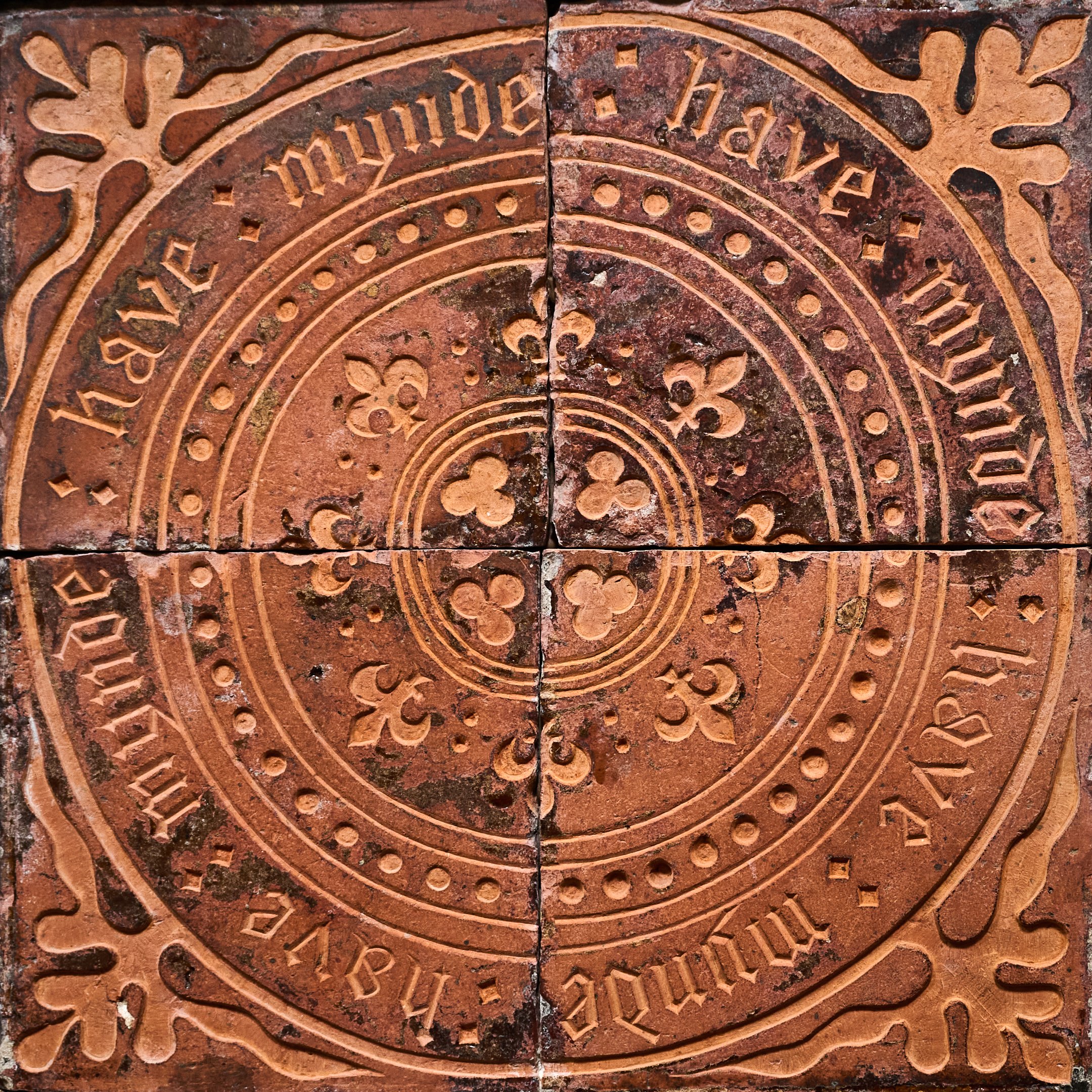
My fieldwork began with a guided tour led by Brother John Leathes, the longest-serving Red Brother. As we walked through the church and grounds, I found myself returning to a simple question: why has this institution endured when so many medieval foundations disappeared, were dissolved, or lost their original purpose? The clues appeared in different forms. Brothers pointed to Saint Cross’s unusual constitutional status as a Royal Peculiar. The Saint Cross name itself repeatedly invoked the Holy Cross. Near the church entrance hangs the Jerusalem Cross associated with the Knights Hospitaller administration of the foundation. Elsewhere, the words Have Mynde appear set into the fabric of the institution. Individually, these seemed little more than historical curiosities. Together, they suggested something more significant. Saint Cross has preserved not merely buildings and traditions, but a remarkably durable sense of identity, continuously reinforced through ritual, symbolism, remembrance, and purpose.
Matins
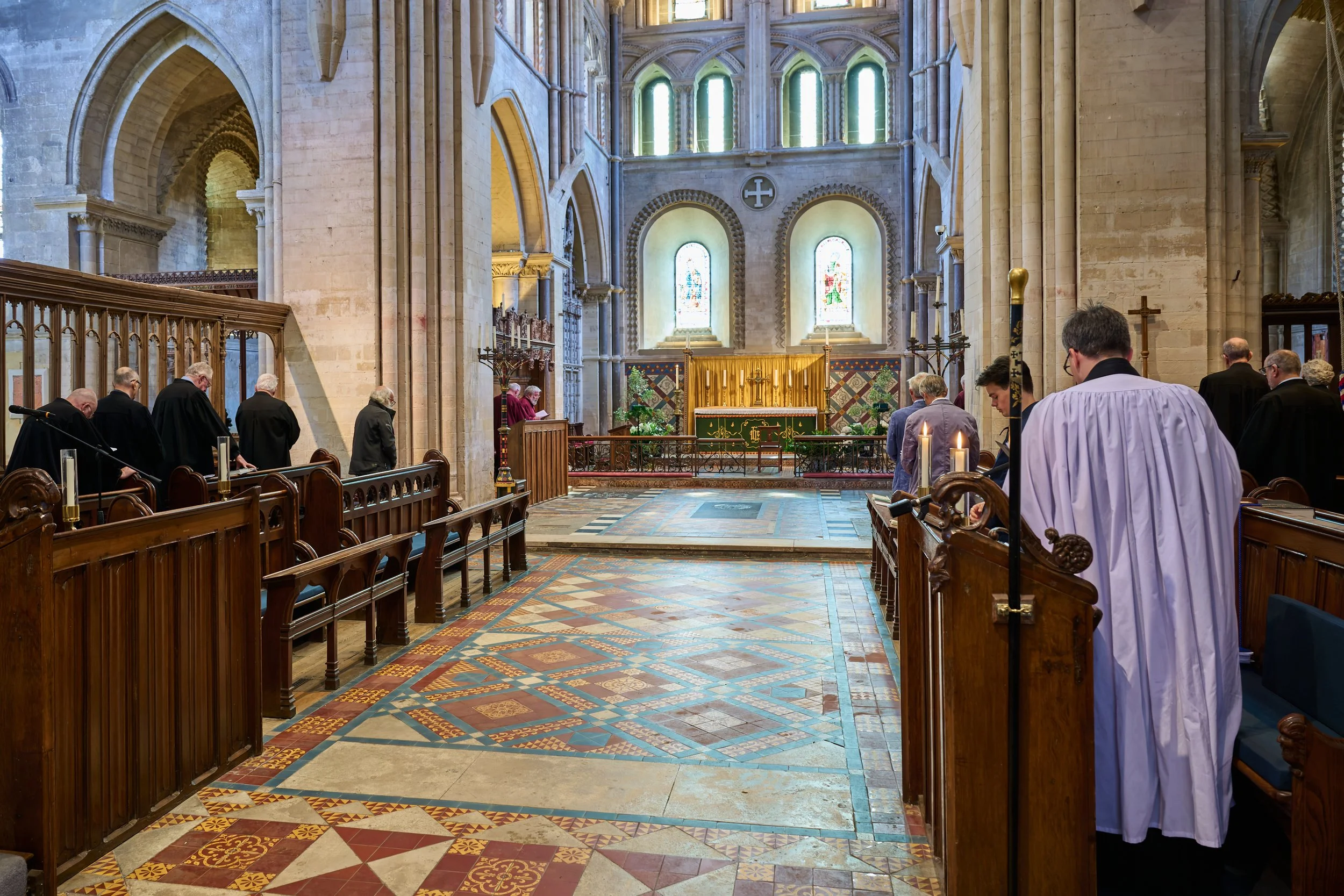
The Master and the Brothers turned together to face the Cross during the Matins service © Martin Urch
Father Dominik Chmielewski, Master of Saint Cross, kindly invited me to attend Matins. For my first attendance, I sat quietly in observance, absorbing the atmosphere and details. What struck me most was the solemnity and adherence to long-established ritual. As Matins began, the Black-robed Brothers gathered in the nave on the north side of the church, opposite the Master, while the Red-robed Brothers occupied the choir stalls beneath the medieval woodwork of the eastern arm. The Red Brothers belong to the Almshouse of Noble Poverty, a second charitable foundation established by Cardinal Beaufort in the fifteenth century, extending Henry of Blois’s vision of care into a new age, yet sharing in the same daily rhythm of prayer.
As the church tower bell chimed ten o’clock, the Brothers rose in unison. Clad in their traditional black and red robes, the scene carried a palpable sense of continuity. The service unfolded through a sequence of prayers, psalms, readings, chants, and responses led by Father Dominik and the Brothers. Most striking was the disciplined rhythm of the ritual. At one point in the service, Father Dominik chanted the next versicle and the Brothers answered in unison. Without instruction, they turned together to face the Cross above the altar. It was a simple movement, made powerful by its precision and shared purpose. Following the formal service, Father Dominik spoke briefly about the Brothers recently departed and the forthcoming funeral arrangements. The moment felt entirely in keeping with the Saint Cross motto, Have Mynde. Beyond the liturgy itself, it was a reminder that remembrance remains woven into the life of the community.
On a subsequent visit to Matins, Father Dominik kindly permitted me to photograph the service. Asked to remain in one position with my camera set to silent, I was aware that I had been entrusted with observing a deeply personal act of communal worship. I remain grateful to Father Dominik and the Brothers for their trust.
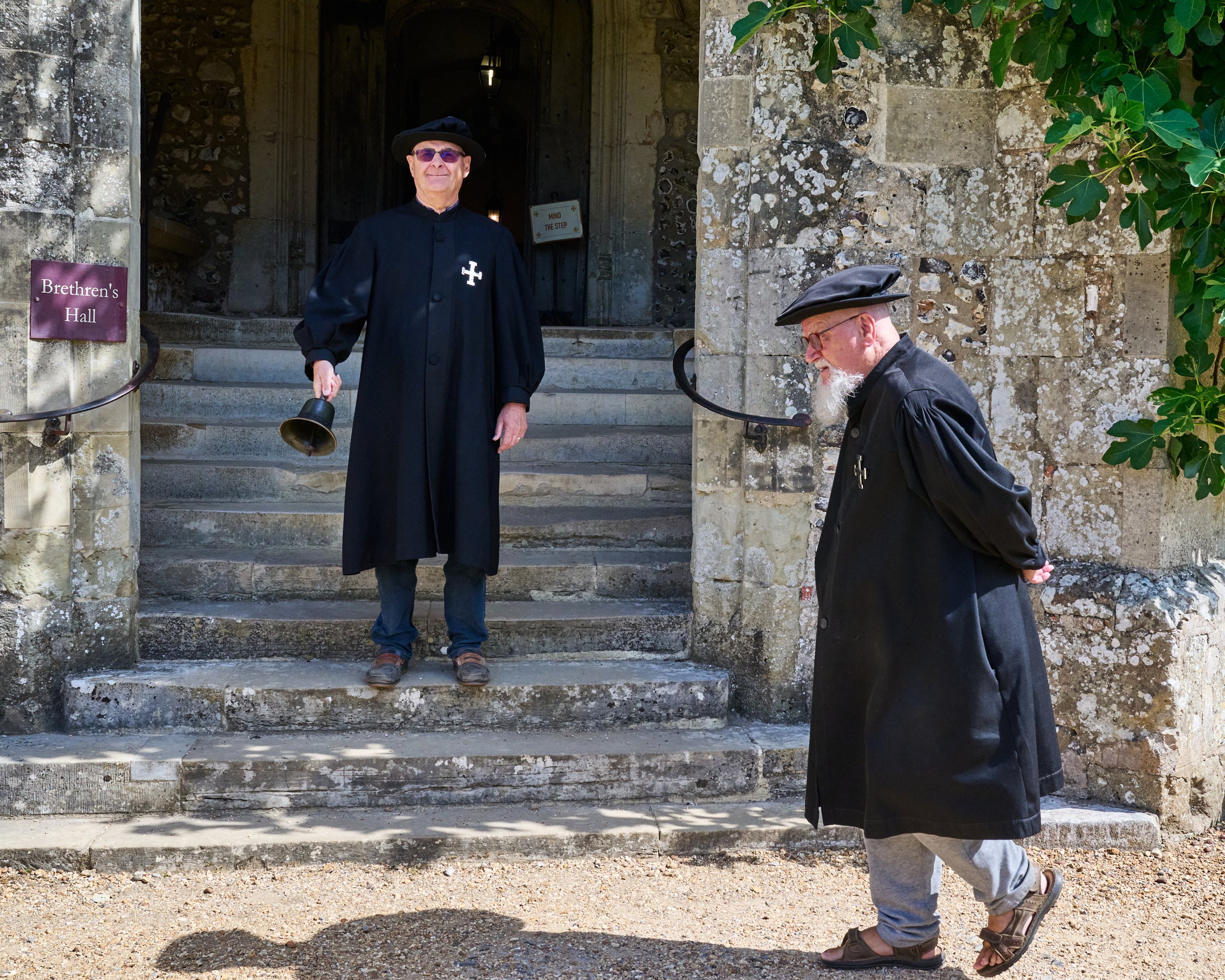
Time is governed by the bell. The newest Black Brother calls for attendance at Pay Parade via the bell. © Martin Urch
Pay Parade
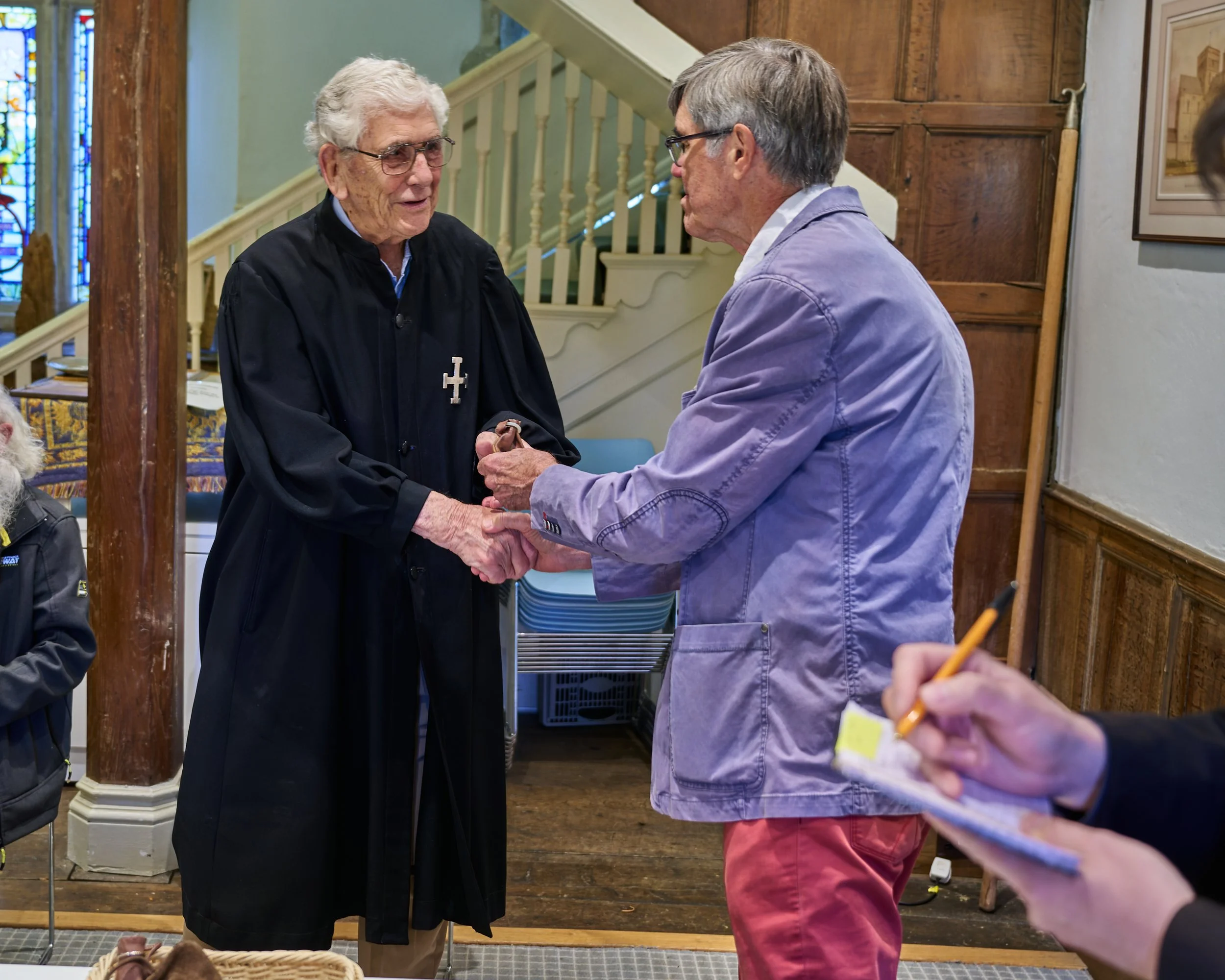
Immediately after Matins, I moved with the Brothers across the courtyard to Brethren’s Hall. As tradition dictates, the newest Black Brother rang a handbell to summon the community to Pay Parade. Various explanations have been offered for the ceremony’s origins, including allowances once provided in place of ale brewed on site or coal supplied for heating. Father Dominik offered a deeper perspective. From its foundation, Saint Cross was intended not only to shelter its Brothers but also to provide for their material needs. In the twelfth century, this support could extend beyond the individual Brother to his wider family during times of hardship and uncertainty. Pay Parade remains a visible expression of that ancient responsibility, preserved long after its practical necessity has faded.
The Brothers remained in their historic robes as Father Dominik read the roll and called each forward in turn. A Trustee presented a small leather pouch containing symbolic coins, which many of the Brothers immediately tossed back onto the table with good humour. The donations are being gathered towards the nine-hundredth anniversary of Saint Cross, with hopes of commissioning a statue of Henry of Blois to stand alongside Cardinal Beaufort on the tower. What struck me was the blend of ceremony and camaraderie. Beneath the laughter and banter lay a ritual that has endured for centuries: a community assembled together, names called in order, provisions distributed, and fellowship renewed. The forms have changed, but the underlying beliefs, responsibilities, and rhythms remain remarkably familiar to those that shaped life at Saint Cross in 1152.
Brothers receive their leather wallet, each containing coins in symbolic continuance of Friday Pay Parade © Martin Urch
Lost Hospital Complex
The 1152 brothers’ accommodation would have been established alongside the hospital itself, although none of the original buildings survives. Archaeological investigations by the Winchester Archaeological Research Group on the Bowling Green, east of the church, uncovered medieval wall footings that may relate to Henry of Blois’s twelfth-century domestic buildings. Their precise purpose remains uncertain, but they offer tantalising evidence of the lost hospital complex. More tangible is the low-vaulted structure adjoining the church’s south transept, now used as the vestry and among the oldest surviving parts of Saint Cross. Built in the 1130s, it stood at the heart of a community whose care had been entrusted to the brethren of the Knights Hospitaller. Nearby, faded medieval wall paintings depicting the martyrdom of Thomas Becket and scenes from Christ’s Passion provide later layers of devotion within a space shaped by centuries of prayer.
Standing within the vestry, the centuries felt less distinct than I had expected. The stone walls surrounding me were already standing, or nearing completion, when Henry of Blois’s foundation was still young. Later generations would gather here before departing on crusade, while countless others sought comfort, guidance, and charity within its walls. Although the paintings belong to a later age than my 1152 narrative, the space itself belongs to the same continuum. My historical reconstruction imagined men moving through these rooms under the discipline and care of the early hospital; the fieldwork revealed the soft light, tranquillity, and sense of purpose that still shape behaviour today. The paintings have faded, and the world beyond the walls has changed, yet the intertwined traditions of prayer, charity, and community continue to inhabit the same stones.
The Cross of Saint Cross
In the north aisle of the church stands a stone-carved Cross set onto one of the Norman pillars. Known today as the Cross of Saint Cross, it is one of the church’s most distinctive features. At first glance, it appears simply another historic carving, yet it embodies a remarkable continuity with the institution’s twelfth-century origins. Research suggests that construction of this section of the church began around eight years after my 1152 story, and it is believed that the masons aligned a nearby window so that sunlight would fall upon its location on the traditional Cross feast days of 3 May and 14 September.
On the appointed feast days, sunlight still reaches across the church. During their tours, Brothers speak of the brief beam of sunlight that appears as its builders are believed to have intended. Wars have come and gone. Dynasties have risen and fallen. The language spoken within Saint Cross has changed. Yet the tradition endures. Standing before the pillar, I found the distance between medieval and modern Saint Cross unexpectedly small. The stone cross and the story attached to it are reminders that Saint Cross has never forgotten the Holy Cross from which it takes its name.
By the end of my visit, the answer to my original question seemed clearer. The survival of Saint Cross cannot be explained by its buildings alone. Its identity has been continuously reinforced through ritual, symbolism, remembrance, and purpose. The name, the cross, the motto, and the traditions all point towards the same conclusion: Saint Cross has endured because it has never forgotten what it is.
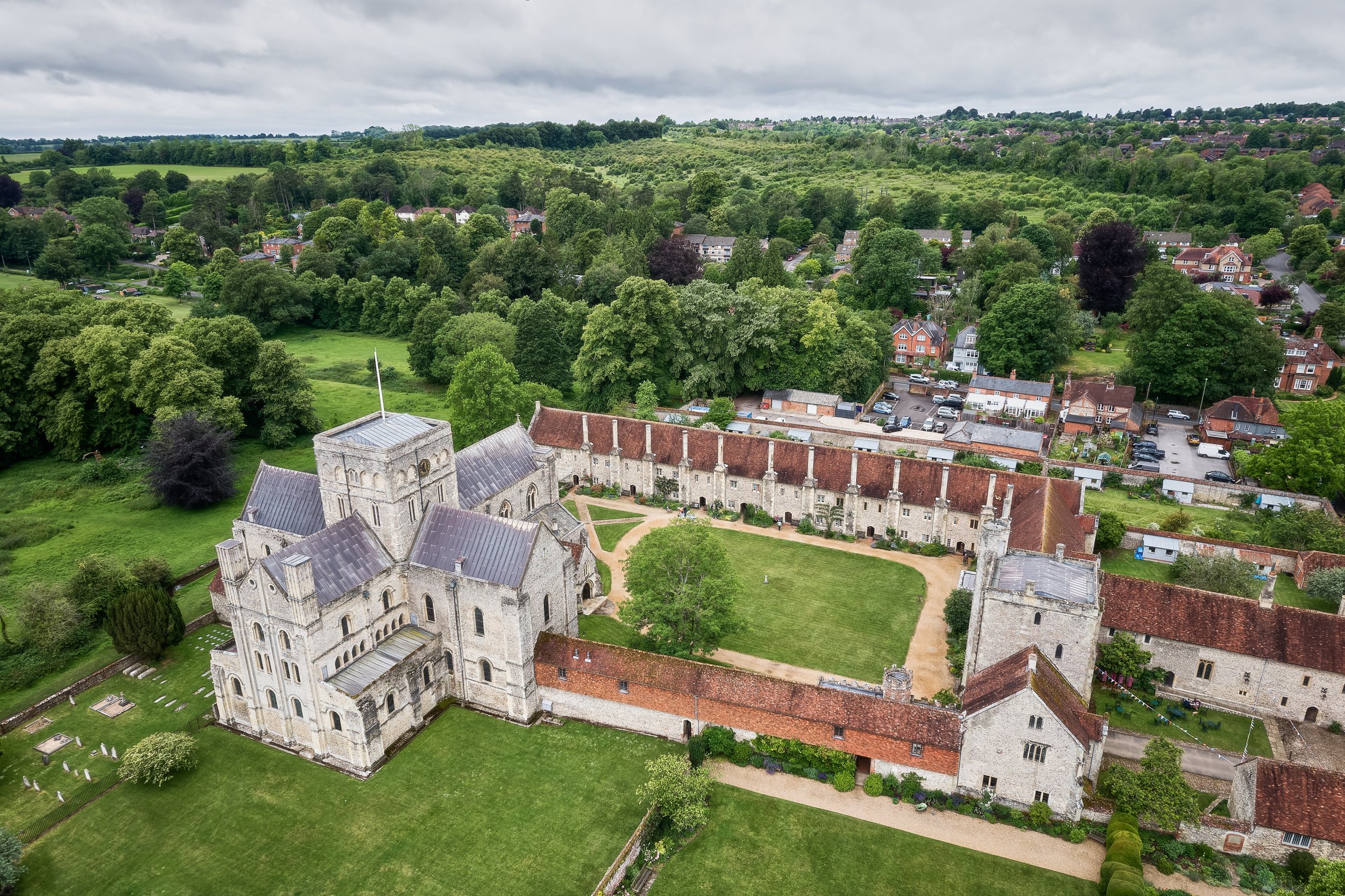
Aerial view of Saint Cross Church, Ambulatory, Tower and Almshouses © Martin Urch
Epilogue: From Holy Cross to Hospital
The story of Saint Cross appears, at first glance, to be a tale of medieval charity: a hospital founded by a powerful bishop amid civil war, sustained by faith, routine, and the care of the poor. Yet as the research unfolded, unexpected threads began to emerge from beyond its walls. Hidden behind familiar accounts of kings, bishops, and institutions are figures whose influence has often been overlooked, as well as legacies that extend far beyond twelfth-century Winchester. Some of the most important forces shaping Saint Cross were not immediately visible in its records, and some of its ideas have endured far longer than its founders could ever have imagined.
1. The Women Behind Saint Cross
Adela — Architect of a Dynasty
Adela of Normandy stood at the centre of one of the most powerful dynastic networks in medieval Europe. Daughter of William the Conqueror, she inherited the political instincts of a family that had reshaped kingdoms through conquest, marriage, and calculated alliance. Raised within the ambitious culture of Norman rule, Adela became far more than a noblewoman managing estates in her husband’s absence. She spoke several languages, governed the County of Blois during the crusade and war, negotiated among bishops and princes, and cultivated a court renowned for intellect, diplomacy, and influence. Chroniclers admired her judgement, yet history gradually folded her into the shadows cast by the men around her.
And yet, few women of the medieval world shaped England more profoundly. Through her sons, Adela came to influence both the crown and the church at the highest possible level. Stephen of England ascended the English throne, while his brother Henry of Blois became Bishop of Winchester and Papal Legate, effectively the most powerful churchman in the kingdom. Together they embodied the twin pillars upon which Norman England rested: secular authority and ecclesiastical power. In the wealthiest realm in Europe at the time, one son ruled the kingdom while the other shaped its spiritual and political machinery. Behind both stood Adela — strategist, mother, and dynastic architect — whose influence reached into the very structure of Norman England.
Matilda — Guardian of a Kingdom
Queen Matilda of Boulogne was one of the principal figures preserving King Stephen’s royal authority. She was far more than Stephen’s wife. During the darkest years of The Anarchy, she raised armies, negotiated with London, secured Stephen’s release after the Battle of Lincoln, and effectively acted as a political and military leader when required.
On the feast day described in this narrative, 3 May 1152, Queen Matilda died at Hedingham Castle. One of the most capable political figures of the age and a crucial supporter of King Stephen throughout the civil war, her passing marked the loss of a powerful force for stability in a kingdom still emerging from years of conflict. While news of her death had yet to reach Winchester on the day of my story, the event serves as a reminder that the routines of Saint Cross unfolded against a backdrop of national uncertainty.
The stories of Adela and Matilda reveal a wider truth. The history of Saint Cross was shaped not only by bishops, kings, and institutions, but also by remarkable women whose influence extended across generations. Their contributions are less visible in the surviving records, yet without them, the political and social landscape in which Saint Cross emerged would have been very different.
2. Hospitallers — A Legacy of Care
While Stephen’s reign descended into violence and uncertainty, Henry of Blois worked constantly to preserve continuity amid collapse. Cast partly as a monk and partly as a statesman, he understood that kingdoms did not survive through castles and armies alone. Stability also depended upon feeding the hungry, sheltering travellers, caring for the elderly, and binding communities together through ritual, charity, and religious obligation. It was within this fractured world that the Hospital of Saint Cross emerged: not merely as an act of medieval piety, but as a deliberate structure against disorder itself.
The institution Henry founded also reveals something deeper about the meaning of the word “hospital”. Derived from the Latin hospitalis, meaning hospitable or welcoming to guests and strangers, medieval hospitals were not originally centres of medicine in the modern sense. They were places of refuge: caring for the poor, the sick, pilgrims, orphans, and the elderly as an expression of both faith and social stability. Only gradually did hospitals evolve into institutions focused primarily upon medical treatment. Yet the older idea of charitable care never disappeared.
The care offered at Saint Cross in 1152 was not an isolated medieval practice. It formed part of a tradition that would evolve through hospitals, almshouses, charities, and organisations such as St John Ambulance. The emblem carried by St John Ambulance still bears the cross of the medieval Knights Hospitaller, formerly known as the Hospital of St John of Jerusalem — a visible reminder that the impulse to shelter, protect, and care for strangers has endured for nearly a thousand years of British history. The forms have changed, but the underlying obligation remains recognisable.
3. The Long Memory of Saint Cross
By the end of this study, four details that first appeared as historical curiosities reveal themselves as the foundations of Saint Cross’s continuity.
The name Saint Cross preserved the institution’s original purpose by anchoring it in the Christian symbolism of sacrifice, redemption, and care for others. The Jerusalem Cross gave that purpose a visible identity, linking a charitable hospital in Winchester to the wider spiritual world of the crusading age and the Hospitaller tradition of service. The motto, Have Mynde, expressed the inward discipline required to sustain the foundation: remember your purpose, remember your duties, remember the brevity of life itself. Finally, Royal Peculiar status provided the constitutional protection that allowed these traditions to survive centuries of political, ecclesiastical, and social change.
Taken together, they reveal why Saint Cross is not simply an old building inhabited by modern residents. It is an institution that has continuously remembered itself. Buildings can survive through preservation. Traditions survive through repetition. But institutions endure when successive generations inherit a clear sense of who they are and why they exist. For almost nine centuries, Masters and brethren have entered a community whose purpose was already defined, whose symbols were already understood, whose rituals reinforced memory, and whose independence protected its character.
The answer to the question that began this study seems unexpectedly simple. Saint Cross endured because it never forgot what it was. Its name preserved its purpose. Its symbols reinforced identity. Its rituals renewed memory. Its independence protected continuity. Across wars, reformations, epidemics, and social change, generation after generation inherited the same story and chose to continue it.
The enduring lesson of Saint Cross is that continuity is not the preservation of the past. It is the continual act of remembering. Have Mynde is more than a motto. It is the principle that has allowed Saint Cross to carry the beliefs, duties, and rhythms of medieval England into the present day.
Have Mynde tiles displayed on the North Transept wall of Saint Cross church.© Martin Urch
Sources
The Master and Brothers of Saint Cross
Henry of Blois: New Interpretations — edited by William Kynan-Wilson & John Munns
The Anarchy: The Darkest Days of Medieval England — Teresa Cole
Warrior Monks: Politics and Power in Medieval Britain — Rory MacLellan
Daily Life in a Medieval Monastery — Rose Graham
St Cross: England’s Oldest Almshouse — Peter Hopewell
The Hospital of Saint Cross: A facsimile of the 1816 1st Edition Guide — Master Rev. Lewis M Humbert
The Hospital of St. Cross and Almshouse of Noble Poverty — John Crook
Winchester Archaeology Group digs at St. Cross, 2007-2009, 2013
Hampshire Record Office, Administrative History catalogue for the Hospital of St Cross.
Enquiries
Enquiries regarding book-length collaborations and extended narrative projects, including works developed in partnership with institutions or archive holders, are welcome.
If you enjoy my work, you can even consider throwing a few pennies into the tip jar. Click the ‘buy me a coffee’ button to help fund my research and writing. Until next time…

What next?
Inside Tudor Minds: Faith, Exile, and the Memory That Refused to Die follows one of the most profound ruptures in British history. Henry VIII’s Dissolution of the Monasteries swept away institutions that had shaped communities for centuries, silencing churches, dispersing monks, and reducing great abbeys to ruins. Yet while buildings could be demolished and lands confiscated, ideas proved far harder to destroy. This chapter will explore how a Catholic way of life, rooted in the Rule of Saint Benedict, survived political upheaval through exile, carrying its memory across the English Channel before returning to England centuries later.
My journey continues in search of overlooked continuity. Inside Tudor Minds shows how an institution survived after its apparent extinction, and how its identity endured without the buildings that once defined it. A 1536 narrative history follows medieval sanctuary, monastic exile, Benedictine devotion, and an extraordinary story of return, exploring the resilience of institutional memory itself. Join me for a journey of loss and renewal, discovering how beliefs, values, and traditions outlived the very places that once gave them a home.
Copyright
Martin Urch Photography owns the copyright to all writing and images
Rights & Reuse
Reuse may be considered on a non-exclusive, fully credited basis, with copyright retained.